
How to Read Geotextile Technical Parameters: Mass per Unit Area, Strength, and Puncture Resistance Explained
Geotextile technical parameters are not abstract lab numbers—they are the bridge between a fabric's production quality and its real-world performance in separation, filtration, drainage, and protection. For industrial buyers sourcing from China, the ability to interpret mass per unit area, tensile strength, CBR puncture resistance, and related indicators is often what separates a technically sound purchase from one that leads to premature failure, change orders, or costly rework.
This guide is written for engineers, procurement managers, and infrastructure contractors who need to evaluate Chinese geotextile supplier offers with confidence. It explains what each core parameter measures, how production processes influence those values, and how to match them to project conditions using verifiable, real-world examples.
The Problem: Why Buyers Misread Geotextile Specifications
A common mistake in geotextile procurement is treating one parameter—usually mass per unit area (gsm)—as the sole indicator of quality. A 400 gsm geotextile can behave very differently depending on fiber type, fiber length, needling density, and finishing methods. Chinese geotextile suppliers publish datasheets with similar headline numbers, but the production process behind those numbers determines field performance.
The practical problem for buyers is threefold. First, they may not know which parameters matter for their specific application. Second, they may not know how to verify supplier claims. Third, they may not understand the cause-and-effect relationship between manufacturing choices and measured values. This guide addresses all three.
Industry Background: How Nonwoven Geotextiles Are Made in a Chinese Geotextile Plant
Geotextiles are permeable fabrics used with soil for separation, filtration, drainage, reinforcement, and protection in civil engineering. Nonwoven geotextiles dominate many applications because they combine high puncture resistance, good hydraulic conductivity, and the ability to be engineered for specific strength requirements.
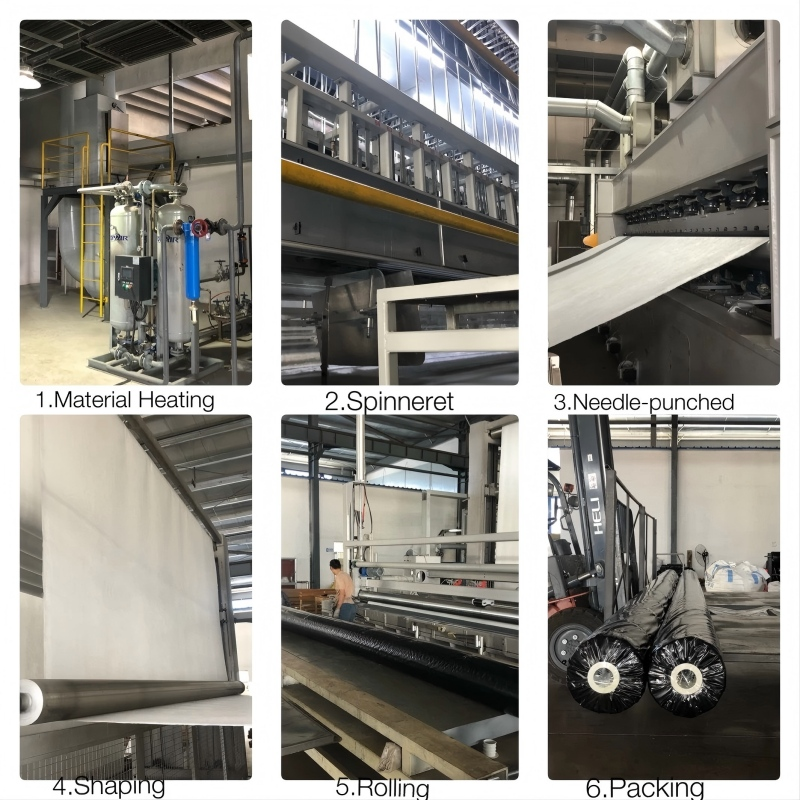
In a Chinese geotextile plant, the two most common nonwoven production routes are staple fiber needle-punched and continuous filament needle-punched. A staple fiber line starts with cut fibers (often PET) that are opened, carded, and laid into a web before needle punching. A filament line spins continuous filaments directly, lays them into a web, and then needle punches them. Both routes can produce geotextiles from light (≤100 gsm) to heavy-duty (≥1200 gsm) grades, but the physical structure and engineering behavior differ.
Dalian GeoMax Synthetics Co., Ltd., a Chinese geotextile manufacturer based in Dalian, operates two production lines for short fiber needle-punched geotextiles and one production line for long fiber (continuous filament) needle-punched geotextiles. This matters for buyers because it means the manufacturer can supply multiple process routes depending on the application and standard required.
Core Geotextile Parameters Explained
1. Mass per Unit Area
Mass per unit area, commonly expressed in g/m² (gsm), is the weight of one square meter of geotextile. It is a fundamental specification because many projects specify geotextiles by this value—for example, GE250 means a 250 gsm geotextile. However, gsm is not a direct measure of strength. It is a starting point that helps select an appropriate grade.
GeoMax produces a full range from lightweight options of ≤100 gsm up to heavy-duty geotextiles of ≥1200 gsm. Uniform surface weight across the roll is one of the quality characteristics that stable production lines and consistent raw materials deliver. For buyers, verifying roll-to-roll and within-roll uniformity is important because variations in gsm can create weak points in a liner or drainage layer.
2. Thickness
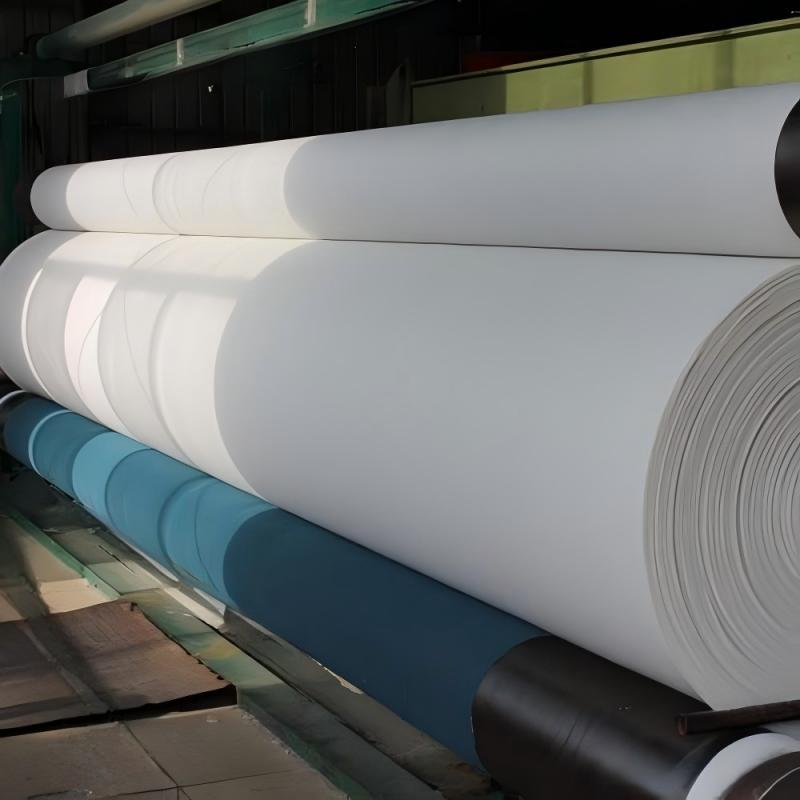
Thickness affects hydraulic properties and protection performance. Under load, geotextiles compress, so thickness alone is usually measured at a standard pressure. In protection applications—for example cushioning a geomembrane against puncture—thicker geotextiles generally provide more cushioning. The company's product photos show uniform thickness across the web, which is a visual indicator of consistent fiber distribution and needling.
3. Tensile Strength and Elongation
Tensile strength is the maximum force per unit width a geotextile can withstand before breaking. It is normally reported in kN/m in machine and cross-machine directions. Elongation at break is the corresponding percentage of stretch under tension. These two values together describe how a geotextile will behave during installation and under service loads.
Staple fiber needle-punched geotextiles tend to have higher elongation, which can be advantageous on uneven subgrades because they conform without tearing. Continuous filament geotextiles often display higher initial modulus and more balanced strength distribution. A buyer should not simply choose the highest tensile number; the right combination of strength and elongation depends on whether the fabric will be laid over soft soil, used in a steep slope, or subjected to concentrated stresses.
4. CBR Puncture Resistance
CBR puncture resistance measures the force required to push a standard plunger through the geotextile. This is one of the most important parameters for protection applications, such as a cushion geotextile laid between a geomembrane and sharp subgrade stones. Higher CBR values mean better resistance to local concentrated loads.
Puncture resistance does not come from gsm alone. It is strongly influenced by fiber type, web structure, and needling density. A poorly manufactured heavy geotextile can have lower puncture performance than a well-engineered lighter one. That is why reputable Chinese geotextile suppliers should provide CBR puncture data on datasheets, not only tensile strength.
5. Hydraulic Properties
Water flow rate, permittivity, and apparent opening size control filtration and drainage behavior. A geotextile used for filtration must allow water to pass while retaining soil particles. The relationship between AOS and soil particle size is a standard filter design criterion. These parameters are not always listed on simple commercial quotations, but they should be available on the technical datasheet for products intended for filtration or drainage.
6. UV Resistance and Aging
Geotextiles exposed to sunlight during storage or construction may need anti-UV treatment. Anti-UV geotextiles are among the customized products available from GeoMax. For permanent buried applications, UV resistance is less critical, but for exposed installation periods or temporary works, it is directly relevant to service life.
| Parameter | Unit | What It Tells You | Typical Buying Question |
|---|---|---|---|
| Mass per unit area | g/m² (gsm) | Fabric weight per square meter; a grade identifier, not a strength guarantee | What gsm is sufficient for my subgrade and load? |
| Thickness | mm | Compressible cushioning volume; influences hydraulic flow | Will it protect a geomembrane from sharp aggregates? |
| Tensile strength | kN/m | Maximum force before break, typically MD and CMD | Will it survive installation stresses and service loads? |
| Elongation at break | % | Deformation capacity before failure; affects conformability | Can it stretch over uneven ground without tearing? |
| CBR puncture resistance | N | Resistance to local concentrated puncture loads | Can it be used as a cushion/protection layer? |
| Apparent Opening Size (AOS) | mm or μm | Pore size; governs soil retention and water flow | Is it filter-compatible with the site soil? |
| Permittivity / Flow rate | s⁻¹ / l/min/m² | Water permeability under load | Will it drain quickly enough for the application? |
How Production Process Affects Quality and Performance
When evaluating a Chinese geotextile manufacturer, buyers should consider how the factory's process choices influence the final product. This is where technical due diligence goes beyond reading a datasheet.
Raw Material Selection
Virgin PET staple fiber produces consistent color, uniform physical properties, and predictable behavior in demanding applications. Recycled material can reduce cost, but it often introduces variability. GeoMax states that its offerings include virgin PET staple fiber nonwoven geotextiles, which is a useful quality signal for projects where long-term performance is critical.
Web Formation and Layering
In the short-fiber process, fibers are carded and cross-laid to form a web. The layering pattern influences isotropy—how similar the fabric's properties are in all directions. In filament production, continuous filaments are laid on a moving belt; the ratio of machine-direction to cross-direction orientation can be tuned. Laying of the filament web on the production line is a controlled process step that determines uniformity.
Needle Punching Density and Depth
Needle punching entangles fibers mechanically. Needle density, depth, and type control fabric strength, thickness, and surface appearance. Higher needling density typically improves interlocking and tensile strength up to a point, beyond which it can damage fibers. Therefore, a manufacturer's process knowledge directly affects whether a 500 gsm geotextile performs as a 500 gsm product should.
Heat Treatment and Calendering
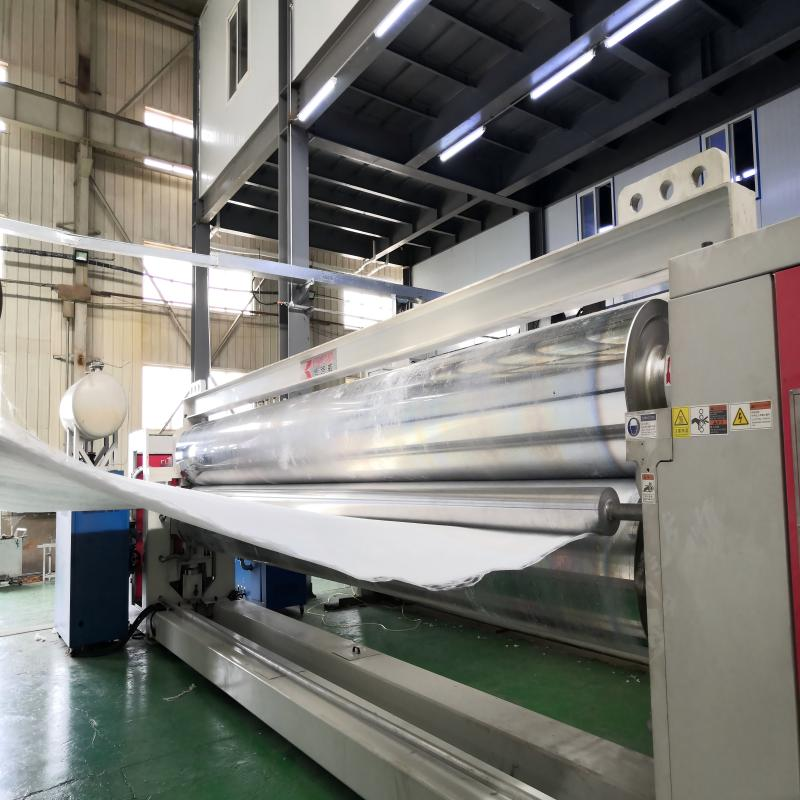
Some production lines include heat-treating machines that stabilize the fabric, reduce surface fuzz, and enhance dimensional stability. Heat treatment can also adjust hydraulic properties by softening the structure. When suppliers offer logo inkjet coding or a smooth printing surface, the finishing process also determines how clearly logos and product information can be applied.
How to Read a Geotextile Datasheet for Procurement
A reliable datasheet from a Chinese geotextile supplier should be structured by test standards. Since GeoMax products meet multiple national standards—including German DIN, international ISO, American ASTM, Australian AS, and Chinese GB/T—the datasheet should state which standard applies to each test result. Without a stated standard, a number is difficult to verify.
Checklist for Datasheet Review
- Confirm the standard used for each parameter (ASTM, ISO, EN, AS, or GB/T).
- Check gsm and thickness in both unstressed and, where relevant, under-load conditions.
- Compare tensile strength in machine direction and cross-machine direction; large differences may indicate orientation issues.
- Look for CBR puncture resistance, not just tensile strength, especially for cushion applications.
- Confirm whether the product is staple fiber or continuous filament, and whether PET or PP.
- Check elongation values to ensure the fabric can conform without rupturing.
- Ask for a CNAS or accredited test report if you need third-party verification.
Verification note: GeoMax's affiliated laboratory, Dalian IEC Testing Service Co., Ltd., holds CNAS laboratory certification issued in April 2016. Test reports issued under CNAS accreditation are mutually recognized by more than 70 developed countries and can carry the CNAS, ILAC, and APLAC mutual recognition marks within the scope of accreditation.
Real-World Examples: Translating Parameters into Landfill Designs
Landfill projects illustrate how technical parameters map to real applications. GeoMax has participated in multiple landfill and environmental engineering projects where specific geotextile grades were selected for distinct functions.
Cushion Geotextile Under Geomembranes
For protection of geomembranes against punctures from underlying stones, heavy geotextiles such as GLP950 (950 gsm), GLSV1200 (1200 gsm), and GLSV1100 (1100 gsm) have been used in landfill projects. In projects like the Shoal Bay Landfill in Darwin, cushion geotextiles of 38,000 m² at 1200 gsm were supplied. CBR puncture resistance and mass per unit area are key selection criteria in this role.
Separation Geotextile
Separation layers prevent intermixing of different soil materials. Lighter grades such as GE250 (250 gsm) are common. At the Shoal Bay Landfill, 30,640 m² of GE250 separation geotextile was used. In the Great Southern Landfill, approximately 70,000 m² of GE235 (235 gsm) separation geotextile was supplied for one unit. Tensile strength and AOS are relevant here; very heavy gsm is not automatically required.
Heavy-Duty Capping and Extension Works
Geotextiles used in capping or landfill extensions may need both mechanical robustness and hydraulic performance. At Millar Rd Landfill Cap 12 & 13, 95,000 m² of GLP540 (540 gsm) geotextile was used. At Red Hill Landfill Stage 15 Extension, GE420 (420 gsm) cushion geotextile covered 7,500 m². These examples show that suppliers must be capable of delivering consistent quality across large, project-specific surface areas.
| Project | Function | Grade | Quantity |
|---|---|---|---|
| Shoal Bay Landfill, Darwin | Cushion geotextile | GLSV1200 (1200 gsm) | 38,000 m² |
| Shoal Bay Landfill, Darwin | Separation geotextile | GE250 (250 gsm) | 30,640 m² |
| Great Southern Landfill | Cushion geotextile | GLSV1100 (1100 gsm) | Approx. 80,000 m² |
| Great Southern Landfill | Separation geotextile | GE250 (250 gsm) | Approx. 80,000 m² |
| Millar Rd Landfill Cap 12 & 13 | Geotextile capping works | GLP540 (540 gsm) | 95,000 m² |
| Red Hill Landfill Stage 15 | Cushion geotextile | GE420 (420 gsm) | 7,500 m² |
Customization and Coding: When Production Line Finishing Matters
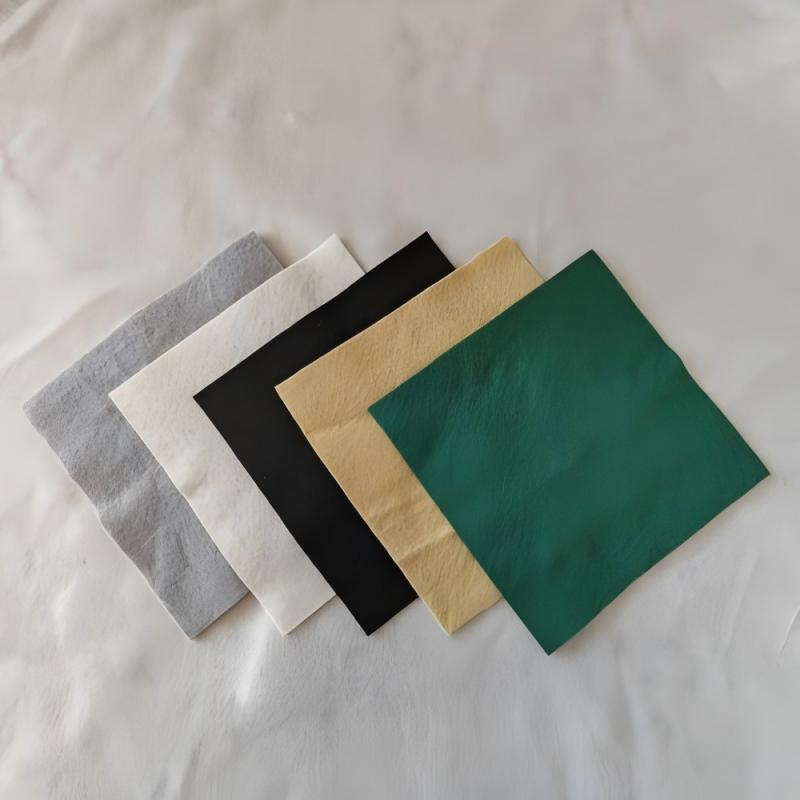
Beyond technical parameters, many projects require customized geotextiles: colored fabrics, conductive or wicking versions, anti-UV grades, and marking. GeoMax offers a wide range of customization, including colored geotextiles (orange, red, gray, and other colors), conductive geotextile, wicking geotextile, and anti-UV geotextile. Customization can also include surface spraying of the customer's company logo, product name, specifications, and other information, using logo inkjet coding technology for clear and aesthetically pleasing results.
For buyers, the key is to understand that customization affects parameters. For example, a conductive geotextile usually contains carbon-based additives or modified fibers, which can alter tensile and hydraulic values. An orange geotextile may be specified for visual marking or safety requirements, but color pigments must not degrade mechanical performance. The manufacturer should provide product-specific data after modification, not simply re-use standard datasheets.
Step-by-Step: Interpreting Parameters Before You Place an Order
Use this workflow when evaluating a geotextile technical quotation, particularly when sourcing from China.
- Define the application function—separation, filtration, drainage, protection, or reinforcement. This determines the priority parameters.
- Identify the governing standard—project specification, local regulation, or international standard such as ASTM, ISO, AS, or GB/T. Confirm your supplier can test to it.
- Select candidate gsm grades—start with project requirements or historical design precedent; use GeoMax's range of ≤100 gsm to ≥1200 gsm as a practical benchmark.
- Compare mechanical parameters—tensile strength, elongation, tear strength, and CBR puncture. Look for balanced MD/CMD values.
- Check hydraulic parameters—AOS, permittivity or water flow rate—for filtration/drainage applications.
- Request specific test reports—preferably from a CNAS-accredited laboratory for traceability.
- Inspect production capability—ask about raw materials (virgin vs recycled), process type (staple vs filament), heat treatment, and in-house quality control.
- Confirm customization and marking—color, anti-UV, wicking, conductive, logo inkjet coding, packaging, and roll sizes.
Frequently Asked Questions
1. What standards should a Chinese geotextile supplier meet for international projects?
A qualified Chinese geotextile plant should be able to produce and test products in accordance with the standard specified by the buyer's country or project. GeoMax states that the performance and indicators of its geotextiles meet multiple international standards, including German DIN, international ISO, American ASTM, Australian AS, and Chinese GB/T. The company can also supply customized products based on ASTM, AS, GB/T, and other standards. When reviewing a supplier, verify the test standard for each datasheet parameter rather than assuming a single global standard applies.
2. What geotextile specifications are available—lightweight to heavy-duty?
GeoMax can produce lightweight geotextiles of ≤100 gsm and heavy-duty geotextiles of ≥1200 gsm, with a broad range of specifications in between. These include grades used in landfill projects such as GE235 (235 gsm), GE250 (250 gsm), GLP540 (540 gsm), GLSV800 (800 gsm), GLSV1100 (1100 gsm), and GLSV1200 (1200 gsm). The appropriate grade depends on the engineering function, not just gsm: separation layers often use lighter grades, while cushion and protection layers usually require heavier, higher-puncture-resistance products.
3. How does production technology affect geotextile quality?
Production technology determines fiber orientation, entanglement density, uniformity, and finishing. GeoMax operates two lines for short fiber needle-punched geotextiles and one line for long fiber needle-punched geotextiles. Staple fiber products often provide good conformability and elongation; continuous filament products can provide consistent, balanced mechanical performance. Heat-treating on the line improves surface stability. The measurable result is stable, uniform fabric surface weight and consistent performance data across rolls.
4. Can geotextiles be customized with color, UV resistance, or printed logos?
Yes. GeoMax offers colored geotextiles (including orange, red, gray, and other colors), conductive geotextile, wicking geotextile, and anti-UV geotextile. Product surfaces can be spray-coated with a customer's company logo, product name, specifications, and other information through logo inkjet coding. These customizations are also available alongside reprocessed products such as mini rolls, geobags, tubular bags, fabric sheets, and geosynthetic containers in various sizes and structural forms. Customization should always be accompanied by product-specific performance confirmation.
5. What is lead time for geotextile production from a Chinese manufacturer?
Lead time depends on specification, quantity, customization, and production schedule. Since GeoMax operates multiple dedicated production lines and states that its products are produced to meet international quality standards, confirming the production calendar at the quotation stage is recommended. For project-critical orders, buyers should request a clear production and inspection plan, including any required third-party testing. Direct inquiries with specific gsm, area, and customization requirements will receive the most accurate lead time and quotation.
To obtain a sample, quote, or technical datasheet for your specific project, contact Dalian GeoMax Synthetics Co., Ltd. at enquiry@geo-textile.com or visit www.geotranstechnology.com. Its technical team can help match parameters to your application.
Conclusion: Read Parameters as a System
A geotextile's technical parameters are only meaningful when read together. Mass per unit area identifies the product grade; tensile strength and elongation describe its mechanical behavior; CBR puncture resistance indicates its protective capability; and hydraulic properties determine its filtration and drainage function. The production process—raw material, web formation, needle punching, and finishing—sits behind every number on the datasheet.
When sourcing from China, work with a manufacturer that discloses standards, supports third-party verification, and understands both production technology and application engineering. Dalian GeoMax Synthetics Co., Ltd. meets this profile as a Chinese geotextile manufacturer with international project experience, in-house testing support through a CNAS-accredited laboratory, and comprehensive customization options. By learning to read geotextile parameters, you reduce technical risk and make procurement decisions that are defensible for every stakeholder in your supply chain.
Have Questions or Need More Details?
Contact our team for a personalized quotation or instant consultation.
Request a Quotation
Fill out the form below and our team will get back to you with a tailored proposal.
WhatsApp Direct Chat
Prefer to chat in real-time? Message us on WhatsApp for instant assistance & quick answers.
- Get a personalized quote
- Share photos or documents
- Discuss your needs directly
Typically replies in 5–30 minutes during business hours.