Geotextile Application Guide: Matching PP Nonwoven Solutions to Road, Hydraulic & Landfill Projects
Geotextile Application Guide: Matching PP Nonwoven Solutions to Road, Hydraulic & Landfill Projects
PP nonwoven geotextile is a needle-punched polypropylene fabric used in civil engineering to separate, filter, protect and disperse stress between soils and construction materials. Which of those jobs it performs is decided by the project, not by the product name: the same nonwoven platform behaves as a stress-dispersion layer under a road, a filtration medium behind a riverbank, and a protective gasket beneath a landfill liner.
This guide matches PP nonwoven solutions to three core project types — road construction and engineering, hydraulic projects including riverbank reinforcement, and environmental protection projects including landfill lining. It covers what the fabric does in each scenario, the selection criteria that follow from it, the shared demand for high UV resistance and low elongation under outdoor exposure, soil and water contact, and how product 1488 from Dalian GeoMax Synthetics Co., Ltd. (brand G-Tex® GE) is positioned across all three.
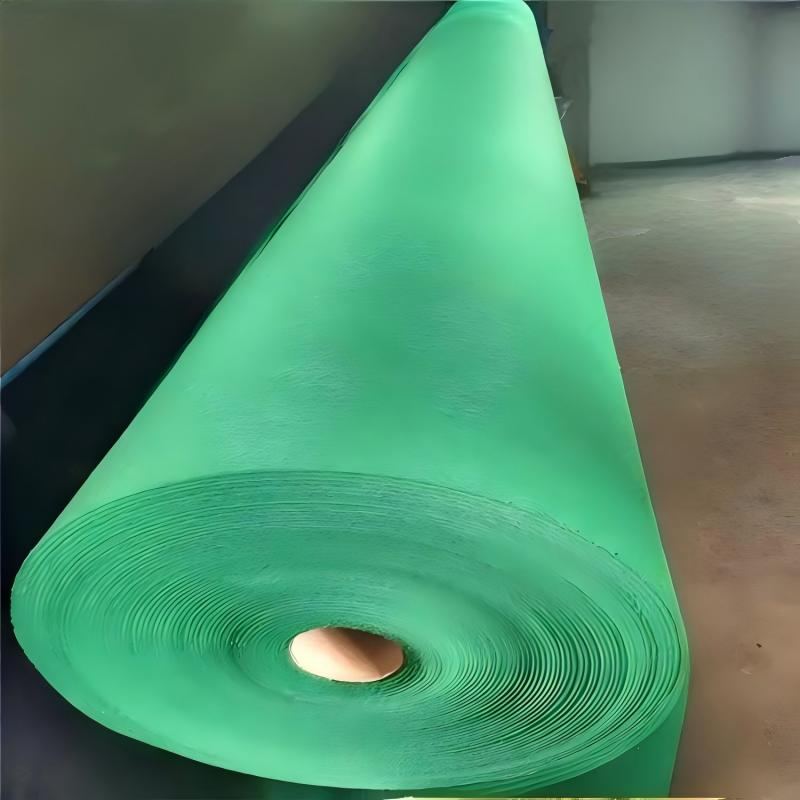
Problem Definition: Why 'Geotextile' Alone Is Not a Specification
Evaluation-stage procurement often reduces geotextile to two variables: mass per unit area and unit price. That framing works for a commodity, but geotextile is a functional material, and the function changes with the project. Three mismatch patterns account for most specification failures.
Function mismatch. In road works the fabric sits between subgrade and aggregate, where it must disperse concentrated loads and stop fines from migrating upward. In hydraulic works the same fabric is asked to pass water while retaining soil — a filtration problem governed by the relationship between the fabric pore structure and local soil gradation. In landfill projects it becomes a gasket and cushion between a geomembrane liner and the layers above and below it. A specification written for one of these roles rarely satisfies the other two.
Exposure mismatch. Installation is not instantaneous. Geotextile is stored outdoors, unrolled, left exposed while the next construction layer is prepared, and then buried in soil or submerged in water for decades. UV degradation during that exposure window, and deformation under tensile load once covered, are the two requirements that recur in every project type. That is why anti-UV geotextile options appear in road, hydraulic and landfill specifications alike, and why UV performance is tested rather than assumed — ASTM D4355 is the core industry standard for testing the UV deterioration of geotextiles via Xenon-Arc exposure (ASTM International).
Documentation mismatch. A fabric can meet a performance target in the laboratory and still fail a project review if the supplier cannot show traceable test evidence against the standard named in the tender. Road projects in the European Union, for example, are covered by the harmonized standard EN 13249:2016, which also requires CE marking for market access (CEN / European Standards).
Practical rule: define the governing function first, then the standard, then the mechanical values, then the exposure conditions. Reversing that order is what produces an order that is cheap and wrong.
Industry Background: A Larger, More Segmented Geotextile Market
Nonwoven geotextiles — the category that includes PP nonwoven geotextile — held the largest product share of the global geotextile market in 2022, accounting for approximately 65.5% of total revenue (Grand View Research). The same source values the global geotextile market at USD 7.10 billion in 2022, projected to reach USD 11.82 billion by 2030, a compound annual growth rate of 6.6%.
China is a central part of that picture. The country accounted for 23.3% of global geotextile market revenue in 2024 and is expected to lead the global market by 2030 (Grand View Research Horizon). China's domestic geotextiles market generated USD 1.85 billion in revenue in 2024, with an expected CAGR of 10.1% through 2030 (Grand View Research). For international buyers, that scale explains why Chinese geotextile manufacture appears on nearly every shortlist — and why due diligence has shifted from availability to documentation consistency.
Market figures should be read as directional. Estimates vary by methodology and by whether 'geotextile' is counted on its own or within total geosynthetics: 2026 estimates range from USD 4.74 billion (Mordor Intelligence) to USD 7.5 billion (Grand View Research). The divergence does not change a procurement decision, but it argues against building a sourcing strategy on a single headline number.
Two product trends now written into technical specifications
Wicking geotextiles. Wicking geotextiles such as Mirafi® H2Ri from Solmax / TenCate use hydrophilic fibers to provide capillary action, transporting water even in unsaturated soil conditions. The implication for road and hydraulic projects is drainage performance in soils that do not drain by gravity alone.
Conductive geotextiles. Conductive geotextiles such as Bidim® C from Geofabrics Australasia use conductive elements to enable Electrical Leak Location (ELL) in geomembrane liners — a quality-assurance capability that landfill specifications increasingly require.
Both trends point the same way: the nonwoven category is segmenting by function. Project type, not price alone, is the correct starting point for an RFQ.
Matching PP Nonwoven Solutions to Each Project Type
Across road, hydraulic and landfill applications the fabric faces the same physical environment: outdoor exposure before covering, then long-term contact with soil and water. The shared demands are therefore UV resistance during the exposure window and dimensional stability — low elongation under tensile load — so the fabric holds position and keeps its separation or filtration geometry once load is applied. What changes between project types is the primary function, and with it the mechanical values that matter most. Table 2 in the Comparison Table section below summarises the differences.
Road construction and engineering: separation and stress dispersion
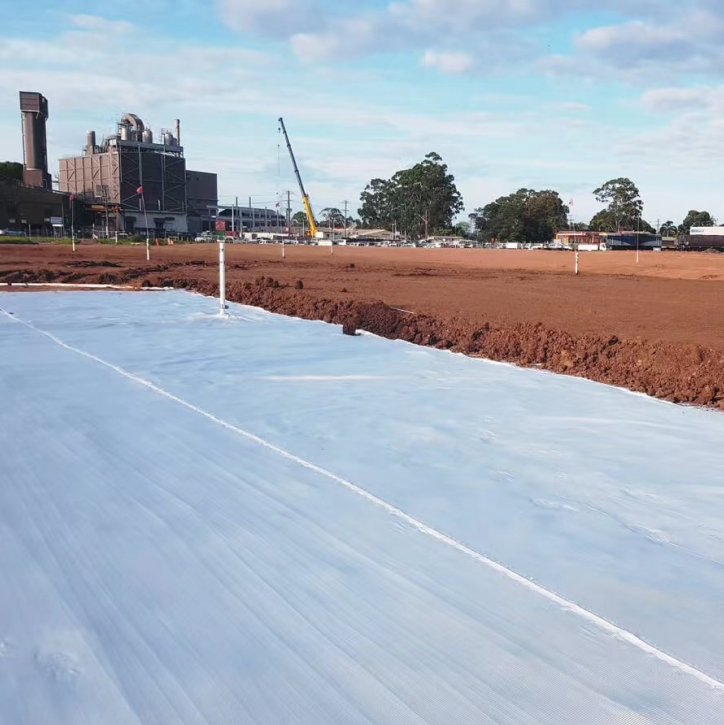
In road construction, a PP nonwoven geotextile acts as a separator and stress-dispersion layer between the subgrade and the granular base. It stops fine subgrade particles from pumping upward into the aggregate, allows water to move through the pavement structure, and spreads concentrated wheel loads over a wider area so the base course retains its designed thickness.
The selection criteria that follow from that function are uniform mass per unit area across the full roll, grab strength and trapezoidal tear resistance, CBR burst strength for resistance to installation damage during compaction, and elongation behaviour under tensile load. Where the project is destined for the European Union, EN 13249:2016 defines the applicable requirements for geotextiles in roads and trafficked areas.
Documented applications in the G-Tex® GE portfolio include geotextile laid on highway subgrade and polyester filament needle-punched geotextile paved on road surfaces, together with municipal works such as the Ola Commercial Park parking lot and a range of expressway and railway projects. On site, rolls are normally positioned with a bulldozer or excavator and the overlying layer is compacted with a roller.
Hydraulic projects: filtration and riverbank reinforcement
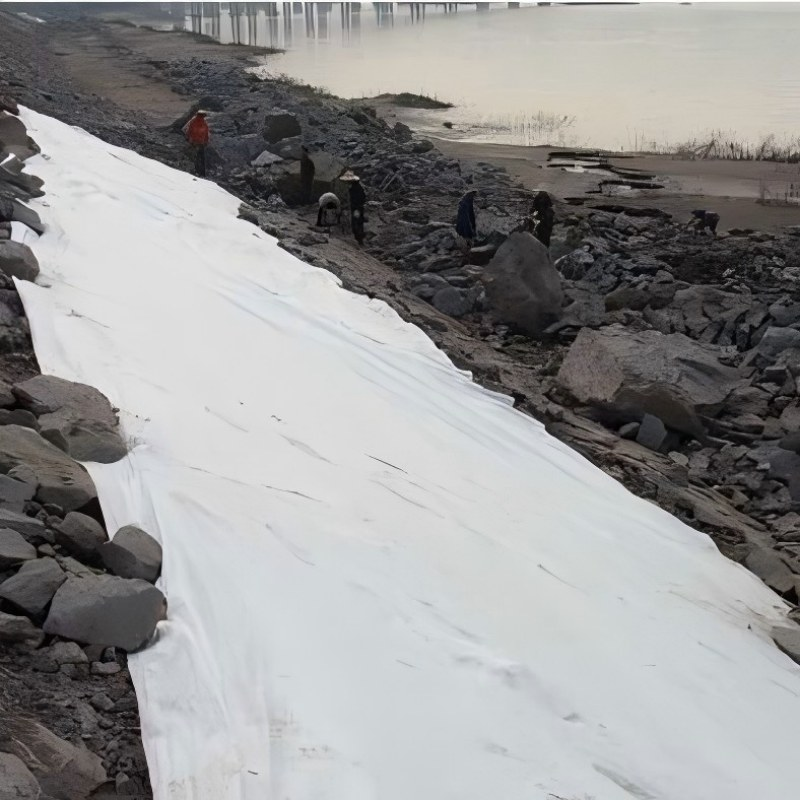
In hydraulic projects — riverbank protection, canals, water conservancy structures — the nonwoven fabric takes on a filtration role. Water must pass through the fabric while soil particles remain behind. If the fabric is too open relative to the surrounding soil, fines wash out and the bank erodes from within; if it is too tight, the fabric clogs and pore pressure accumulates behind it.
Selection therefore begins with soil gradation and the required filtration behaviour, then adds uniform mass per unit area, tensile strength for anchoring at the toe and crest, and UV durability for the period before armour or vegetation is established. G-Tex® GE reference applications include laying geotextile for riverbank protection and water conservancy projects. Excavators and cranes are typically used to place rolls on sloped or waterside terrain where manual handling is impractical. Where a project needs drainage of unsaturated soil rather than filtration alone, a wicking geotextile can be specified within the same product family.
Environmental protection projects: landfill lining and capping
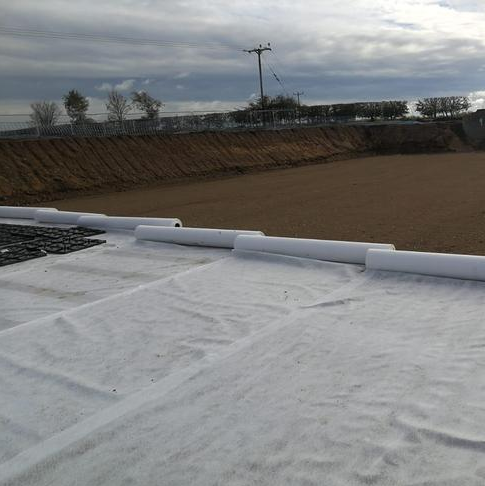
In landfill and environmental protection projects the geotextile works as a gasket and protective layer. It cushions a geomembrane liner against puncture by stones and backfill, disperses stress from overlying loads, and separates drainage layers from waste or soil. Selection emphasis shifts to puncture and CBR burst resistance, mass per unit area and long-term durability, because the fabric remains in service for the life of the containment system. Where leak detection is required, a conductive geotextile supports Electrical Leak Location testing.
G-Tex® GE's documented landfill work covers multiple international sites, with specified geotextiles ranging from 150 g/m² polyester fiber geotextile in a capping stage to 1,200 g/m² polyester fiber geotextile combined with 250 g/m² geotextile in a full liner build-up (see Table 3). Excavators and cranes handle roll placement, and backfill is placed under controlled conditions to avoid damaging the liner system.
Product 1488: One Platform Across All Three Industries
Product 1488 — the geotextile and PP nonwoven geotextile platform from Dalian GeoMax Synthetics Co., Ltd., sold under the brand G-Tex® GE — is documented as applicable to hydraulic engineering, road engineering and environmental protection engineering, the three project types covered above. Its model designations are GLS-V, GE, GLP, PET and PP, it is produced in PET and PP materials, and its documented functions are filtration, stress dispersion and gasket applications.
The platform covers a wide performance window, which is what allows one product family to serve three project types without re-tooling.
| Product 1488 parameter | Documented value | Why it matters by project type |
|---|---|---|
| Material | PET / PP | PP nonwoven for separation, filtration and gasket layers; PET options for documented landfill liner build-ups |
| Widths | Wide widths | Fewer overlaps, faster installation on roads, banks and liner fields |
| Tensile strength | 7.0–95 kN/m | Anchoring at riverbank toe and crest; tensile demand under fill |
| Grab strength | 500–7,500 N | Handling and installation robustness on site |
| Trapezoidal tear | 200–2,500 N | Resistance to tearing around sharp aggregate and backfill |
| CBR burst strength | 1,300–12,500 N | Puncture protection above subgrade and beneath geomembrane liners |
| Customization | Wicking, anti-UV, Orange, Logo Inkjet coding, conductive geotextile, geotextile fabrics | Anti-UV for exposure, wicking for drainage, Orange for on-site visibility, inkjet coding for roll identification, conductive for leak location |
Customization lets the same platform be tuned per project. Options documented in the G-Tex® GE range include wicking geotextile, anti-UV geotextile, Orange geotextile for high-visibility marking on site, Logo Inkjet coding geotextile that prints a company logo, product name or specification onto the fabric surface, conductive geotextile, and additional geotextile fabrics. The range extends beyond rolls to geotextile membrane, drainage geonet, drainage geocomposites, geocell, geomembrane liners and HDPE geomembrane, and material can be re-processed into mini rolls, geobags, tubular bags, fabric sheets and geosynthetic containers.
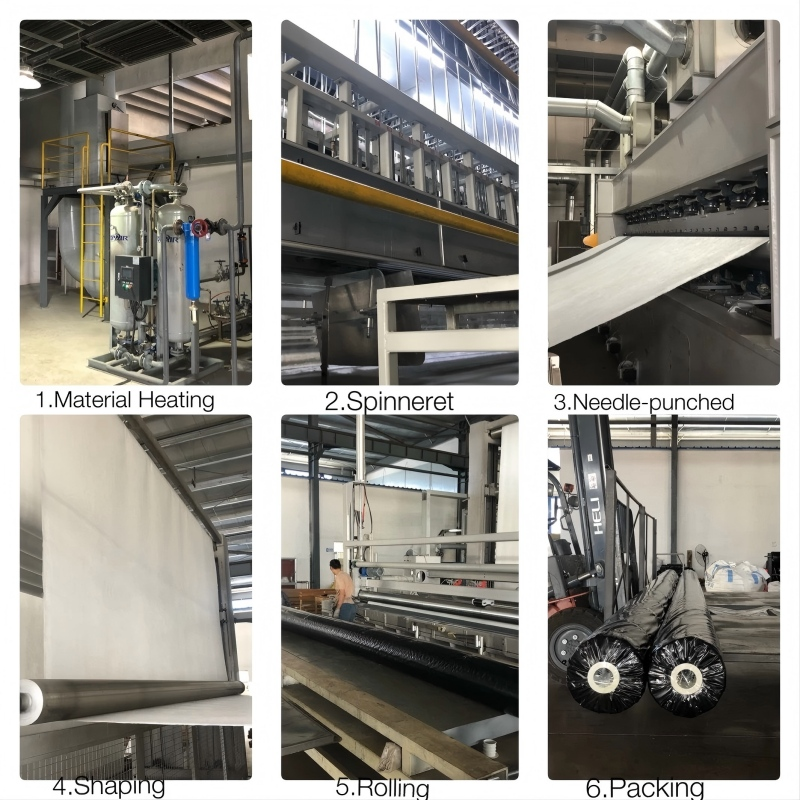
Manufacturer facts relevant to evaluation: Dalian GeoMax Synthetics Co., Ltd. is based in Dalian, China, exports 95% of its output to markets across Asia, Europe, the Americas, the Middle East, Africa and Oceania (more than 30 countries), and operates a 12,000 m² production base with 45 employees, 12 R&D engineers and an annual output of 9,500,000 m². The company holds ISO9001 (03824Q07540R0S), ISO14001 (03824E07541R0S) and ISO45001 (03824E07542R0S) certification, a Chinese High-tech Enterprise certificate (GR202221201470, issued 14 December 2022 and valid to 21 December 2028), and CNAS laboratory accreditation CNAS L8463.
Step-by-Step Breakdown: Matching Product to Site Conditions
- Define the governing function. Separation and stress dispersion, filtration, or gasket and protection. This single decision determines which mechanical values matter, and it is the point at which road, hydraulic and landfill specifications diverge.
- Confirm the standard for the destination market. EN 13249:2016 with CE marking for EU road and trafficked-area projects; ASTM D4355 for UV testing; DIN, ISO, ASTM, AS or GB/T where the tender or local authority requires them. Dalian GeoMax Synthetics produces to these standards and can supply customized product to ASTM, AS and GB/T requirements.
- Set mass per unit area and mechanical targets. Anchor the specification against the documented performance window (tensile 7.0–95 kN/m, grab strength 500–7,500 N, trapezoidal tear 200–2,500 N, CBR burst 1,300–12,500 N) and against comparable reference projects rather than against a single quoted weight.
- Quantify exposure. How long will the fabric stay uncovered, will it sit in standing water, how angular is the backfill, and what is the required design life? These answers decide how much anti-UV treatment and how much puncture resistance the order needs.
- Select customization. Anti-UV for long exposure, wicking for unsaturated-soil drainage, Orange for site visibility and inspection, Logo Inkjet coding for roll identification and traceability, conductive geotextile where liner leak location is required.
- Validate with samples and test documentation. Sample validation confirms surface weight uniformity and handling behaviour; accredited test reports confirm the numbers. Production is 100% tested, and the affiliated laboratory — Dalian I.E.C Testing Service Co., Ltd., accredited as CNAS L8463 under ISO/IEC 17025:2017 — issues reports that can carry the CNAS, ILAC and APLAC marks within its accredited scope.
- Align supply and installation. MOQ is 10,000 m², lead time 10–45 days and monthly capacity 800,000 m². Plan overlaps, anchoring and the covering sequence together with the site equipment set — bulldozer or excavator for positioning, crane for sloped or waterside placement, roller for compaction of the overlying layer.
Use Cases: Three Documented Project Patterns
Landfill lining and capping
Documented landfill references span Australia and Myanmar and include Anslow Grade IV backfill soil, Darwin Bay Landfill, Hongshan Landfill (15th phase expansion), Meru Geraldton Landfill, Mira Road Landfill Zones 12 and 13, Great South Landfill Unit 1, Wylie Bay Landfill, Alawuna Farm Landfill Units 1 and 2, Yulibury Landfill, Tirawa Landfill Project, Cosgrove Landfill, Hoxbury Landfill, Nusa Landfill and MUJI Landfill. The specified geotextiles range from 150 g/m² polyester fiber geotextile for a capping stage to 1,100–1,200 g/m² polyester fiber geotextile in full base-liner build-ups, frequently combined with a lighter 235–250 g/m² geotextile layer.
Road and municipal infrastructure
Road applications include geotextile laid on highway subgrade, needle-punched geotextile paved on road surfaces, and municipal works such as the Ola Commercial Park parking lot, alongside expressway and railway projects. In these projects the fabric carries separation and stress-dispersion duty: keeping subgrade fines out of the base course and spreading wheel loads across a wider area.
Riverbank and water conservancy works
Hydraulic applications include geotextile laying for riverbank protection and water conservancy projects, where the fabric filters water through the bank while holding soil in place. Wicking variants address the drainage side of the same problem in unsaturated soils.
Shared outcome data: the products feature uniform fabric surface weight and stable quality, with performance indicators meeting the industry standards of multiple countries. They have been used by trade companies and engineering construction companies, deployed in Australia, Canada, China, Fiji, Hong Kong, Indonesia, Malaysia, New Zealand and the United States, at an output of 9,500,000 m² per year, with stable operation results. Under normal engineering conditions the design life exceeds 50 years, with project duration reported at 50–100 years.
Comparison Table
Table 2 maps the three project types against function, selection focus and the equipment typically used on site.
| Project type | Primary function of the nonwoven | Selection focus | Documented G-Tex® GE application | Typical site equipment |
|---|---|---|---|---|
| Road construction and engineering | Separation and stress dispersion between subgrade and aggregate; gasket layer | Uniform mass per unit area, grab strength, trapezoidal tear, CBR burst strength, low elongation under load | Geotextile laid on highway subgrade; needle-punched geotextile paved on road surfaces; Ola Commercial Park parking lot; expressway and railway projects | Bulldozer, excavator, roller |
| Hydraulic projects (riverbank reinforcement, water conservancy) | Filtration and soil retention under water contact | Filtration behaviour against local soil gradation, uniform surface weight, tensile strength for anchoring, UV durability | Laying of geotextile for riverbank protection; water conservancy projects | Excavator, crane, waterside handling equipment |
| Environmental protection projects (landfill lining and capping) | Gasket and protective layer beneath geomembrane liners; stress dispersion | Puncture and CBR burst resistance, mass per unit area, long-term durability, conductive option for leak location | Landfill liner and capping packages in Australia and Myanmar — see Table 3 | Excavator, crane, controlled backfill equipment |
Table 3 lists the geotextile specifications documented in named landfill projects, which buyers can use as a realistic reference band when writing their own tender.
| Documented project | Geotextile specified | Application context |
|---|---|---|
| Anslow Grade IV backfill soil | 950 g/m² polypropylene short fiber geotextile and 250 g/m² polyester long fiber geotextile | Environmental protection / backfill soil |
| Darwin Bay Landfill | 1,200 g/m² polyester fiber geotextile and 250 g/m² polyester geotextile | Landfill lining |
| Hongshan Landfill — 15th Phase Expansion Project | 420 g/m² polyester filament geotextile | Landfill expansion |
| Meru Geraldton Landfill | 540 g/m² polyester fiber geotextile | Landfill lining |
| Mira Road Landfill — Zones 12 and 13 | 540 g/m² polyester fiber geotextile | Landfill lining |
| Great South Landfill Unit 1 (formerly Alawuna Farm) | 1,100 g/m² polyester fiber geotextile and 235 g/m² polyester filament geotextile | Landfill base liner |
| Wylie Bay Landfill — first stage | 150 g/m² polyester fiber geotextile | Capping |
| Alawuna Farm Landfill Units 1 and 2 | 1,100 g/m² and 250 g/m² polyester fiber geotextile | Landfill base liner |
FAQ
Which standards apply to PP nonwoven geotextile in road, hydraulic and landfill projects?
For European road and trafficked-area projects, EN 13249:2016 is the harmonized standard and CE marking is required for market access (CEN / European Standards). UV deterioration is commonly tested to ASTM D4355, the core industry standard for Xenon-Arc exposure testing (ASTM International). Beyond these, geotextile specifications are frequently written against German DIN, international ISO, American ASTM, Australian AS and Chinese GB/T standards. Dalian GeoMax Synthetics Co., Ltd. produces to these standards and can supply customized products to ASTM, AS and GB/T requirements. The company holds ISO9001 (03824Q07540R0S), ISO14001 (03824E07541R0S) and ISO45001 (03824E07542R0S) certification, plus a Chinese High-tech Enterprise certificate (GR202221201470, valid to 21 December 2028).
Can PP nonwoven geotextile be customized for landfill and hydraulic projects?
Yes. Within the G-Tex® GE range, customization covers wicking geotextile, anti-UV geotextile, Orange geotextile, Logo Inkjet coding geotextile, conductive geotextile and other geotextile fabrics, with ODM support. Product 1488 (models GLS-V, GE, GLP, PET, PP) is offered in PET and PP and documented for hydraulic engineering, road engineering and environmental protection engineering, with a tensile range of 7.0–95 kN/m, grab strength of 500–7,500 N, trapezoidal tear of 200–2,500 N and CBR burst strength of 1,300–12,500 N. Material can also be re-processed into mini rolls, geobags, tubular bags, fabric sheets and geosynthetic containers.
What drives the cost of a PP nonwoven geotextile order?
Cost is driven by the specification rather than by a single unit price: mass per unit area, roll width, polymer and fiber type (PP or PET), customization such as anti-UV treatment, wicking fibers, conductive elements or Logo Inkjet coding, the scope of test documentation required, order volume relative to the 10,000 m² minimum order quantity, and freight to the destination market. Because these variables change the fabric itself, comparing quotations without normalizing them to the same function, standard and test scope produces misleading results. The 100% test regime and accredited reporting are part of what a quotation is buying.
How can buyers validate PP nonwoven geotextile quality before mass production?
Sampling and test documentation are the two levers. Samples let the buyer confirm surface weight uniformity, roll consistency and handling behaviour against the project requirement. Test evidence can come from an accredited laboratory: Dalian GeoMax Synthetics operates Dalian I.E.C Testing Service Co., Ltd., accredited as CNAS L8463 under ISO/IEC 17025:2017 (valid to 19 April 2028), which tests geotextiles, geomembranes and geocells in accordance with recognized domestic and international standards. Reports issued within the accredited scope can carry the CNAS, ILAC and APLAC marks and are mutually recognized in over 70 developed countries. Production runs are 100% tested.
What are the minimum order quantity and lead time for PP nonwoven geotextile?
MOQ is 10,000 m², production lead time is 10–45 days depending on specification and customization level, monthly capacity is 800,000 m² against annual output of 9,500,000 m², and 95% of output is exported to markets across Asia, Europe, the Americas, the Middle East, Africa and Oceania. To move from evaluation to a confirmed specification, request a sample or quotation with your project type (road, hydraulic or landfill), the governing standard and the required test report — contact Dothan at Dothan@geo-textile.com or WhatsApp +86 186-9865-5505, or download the company brochure using the link below.
Conclusion
Matching PP nonwoven solutions to a project is a sequence, not a single choice. Road construction asks for separation and stress dispersion, hydraulic projects ask for filtration and soil retention under water contact, and landfill projects ask for a gasket and protective layer beneath a geomembrane liner. All three depend on the same underlying qualities: uniform mass per unit area, stable mechanical performance, UV resistance during outdoor exposure, and low elongation so the fabric keeps its geometry once loaded.
Product 1488 from Dalian GeoMax Synthetics Co., Ltd. is documented as suitable across hydraulic engineering, road engineering and environmental protection engineering, with a tensile window of 7.0–95 kN/m, grab strength of 500–7,500 N, trapezoidal tear of 200–2,500 N and CBR burst strength of 1,300–12,500 N, supported by ISO9001, ISO14001 and ISO45001 certification and CNAS-accredited laboratory testing. Buyers who define function, standard, mechanical values and exposure before comparing price will find the comparison far shorter — and far more reliable.

Next step: match the fabric to your project
Send your project type (road, hydraulic or landfill), the applicable standard and the exposure conditions, and G-Tex® GE will respond with a product recommendation, sample arrangement and quotation. Visit geotranstechnology.com to review the full range, or download the company profile brochure: I.E.C. PROFILE (PDF).
Email: Dothan@geo-textile.com | Tel / WhatsApp: +86 186-9865-5505 | Address: NO.8888-1 SOUTH-EASTERN INDUSTRIAL ZONE, YOUJIA, GANJINGZI DISTRICT, DALIAN, CHINA
Have Questions or Need More Details?
Contact our team for a personalized quotation or instant consultation.
Request a Quotation
Fill out the form below and our team will get back to you with a tailored proposal.
WhatsApp Direct Chat
Prefer to chat in real-time? Message us on WhatsApp for instant assistance & quick answers.
- Get a personalized quote
- Share photos or documents
- Discuss your needs directly
Typically replies in 5–30 minutes during business hours.