
PP Nonwoven Geotextile vs Alternatives: A Buyer's Comparison for Road, Hydraulic and Landfill Projects
PP Nonwoven Geotextile vs Alternatives: A Buyer's Comparison for Road, Hydraulic and Landfill Projects
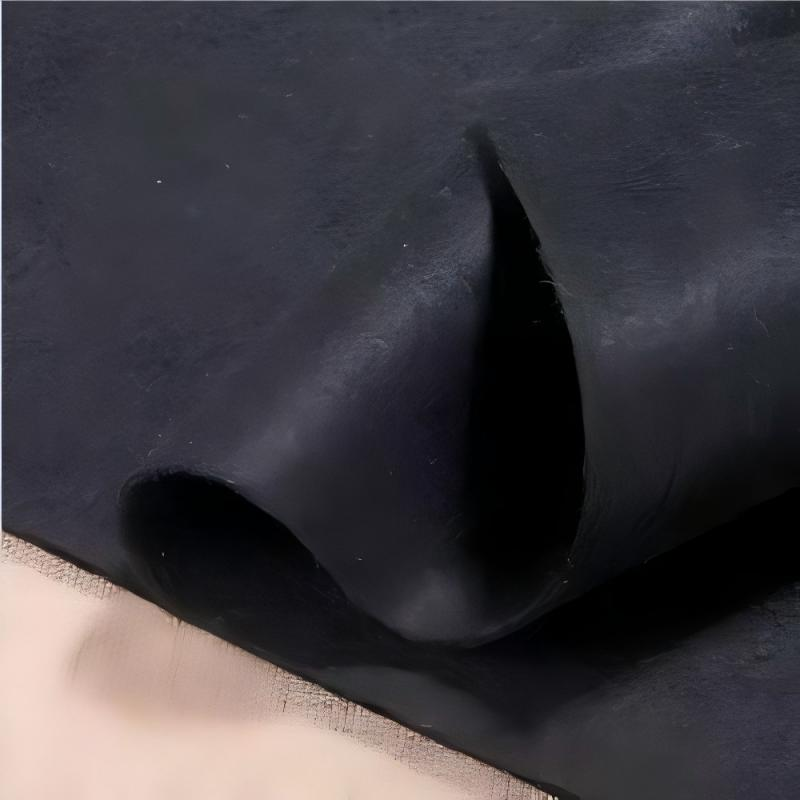
Short answer: PP nonwoven geotextile is normally the correct layer when a project needs filtration, stress dispersion and gasket action in one fabric — most often in road subgrade separation, river embankment protection and landfill lining. It is not automatically the correct choice when the dominant requirement is lateral drainage (wicking geotextile), electrical leak location (conductive geotextile) or absolute containment (geomembrane liner). The comparison that actually decides a purchase is not "which geotextile is best", but "which documented behaviour does this load case demand".
This guide compares PP nonwoven geotextile against the alternatives that appear in the same tenders: PET continuous-filament nonwoven geotextile, wicking geotextile, conductive geotextile and geomembrane liner systems. The reference product is product 1488 in the G-Tex® GE range (model designations GLS-V, GE, GLP, PET and PP), produced by Dalian GeoMax Synthetics Co., Ltd., a Chinese geotextile supplier based in Dalian, China, that exports geotextiles and geosynthetics to more than 30 countries and regions. Specification statements below are drawn from the manufacturer's documented data or from published third-party sources; where a statement describes normal construction practice, it is written as practice rather than as a product claim.
Four variables decide the comparison before price is discussed:
- Exposure — how long the fabric stays open to sunlight before it is covered. This is why UV resistance is specified at all.
- Strain behaviour — whether the fabric must deform with a settling subgrade or hold its geometry under a permanent load. This is why elongation matters.
- Contact medium — soil only, soil and water, or soil and leachate. This governs filtration compatibility.
- Loading regime — short-term construction loading versus static long-term loading under a permanent structure.
Why the "right geotextile" decision is harder than the datasheet suggests
Geotextile is a product family, not a specification. Nonwoven geotextiles held the largest global product share in 2022, accounting for approximately 65.5% of total geotextile revenue according to Grand View Research. That single figure explains a common procurement problem: most quotations a buyer receives will be for nonwoven material, yet "nonwoven" covers staple-fibre polypropylene, continuous-filament polyester and specialty variants such as wicking and conductive fabrics, and those behave differently in the ground.
The second problem is vocabulary. In product 1488, one PP nonwoven layer is documented as performing filtration, stress dispersion and gasket action simultaneously. When three suppliers quote the same physical roll as "separation", "protection" or "drainage", the buyer is comparing words rather than performance. The practical fix is to convert the project requirement into the function that dominates failure risk, then require every quotation to answer that function with a test value.
The third problem is that the two risks which most often cause disputes appear nowhere in a headline product name. The first is UV degradation of fabric left exposed during staging, cutting and installation. ASTM D4355 is the core industry standard for testing UV deterioration of geotextiles through Xenon-Arc exposure, and it is the test to request whenever a project involves meaningful outdoor exposure before cover. The second is elongation under static long-term loading. A fabric that stretches beyond its design envelope under a permanent load stops distributing stress and begins acting as a tension member it was never selected to be.
Finally, treat market numbers with care. Published 2026 estimates for the same category diverge — Grand View Research and Mordor Intelligence publish materially different global figures because they define the boundary of "geotextile" differently. That divergence is a useful reminder that supplier selection should be anchored on standards, test reports and project references rather than on market-size headlines.
What the geotextile market looks like from a procurement desk in 2026
The category is expanding, and the supply base is shifting. Grand View Research valued the global geotextile market at USD 7.10 billion in 2022 and projects USD 11.82 billion by 2030, a compound annual growth rate of 6.6%. Within that total, China accounted for 23.3% of global geotextile market revenue in 2024 and is expected to lead the global market by 2030, while China's domestic geotextiles market alone generated USD 1.85 billion in revenue in 2024 with an expected CAGR of 10.1% through 2030.
Two structural facts follow from this for buyers comparing PP nonwoven with alternatives.
The first is that nonwoven remains the default format. With nonwoven geotextiles holding roughly 65.5% of global product revenue in 2022, PP and PET nonwoven fabrics are the benchmark against which every other option — wicking, conductive, geocomposite, geomembrane — is priced and specified.
The second is regulatory rather than commercial. EN 13249:2016 is the harmonised European standard for geotextiles used in roads and trafficked areas, and it requires CE marking for EU market access. Buyers specifying for European road projects are therefore not comparing free-form product claims; they are comparing suppliers who can document conformity and suppliers who cannot. This is also why export-oriented Chinese manufacturers commonly align production to multiple national frameworks at once — the German DIN standard, international ISO standards, American ASTM standards, Australian AS standards and the Chinese GB/T national standard — and offer customisation to ASTM, AS or GB/T requirements when a project demands it.

The PP nonwoven option, explained through product 1488
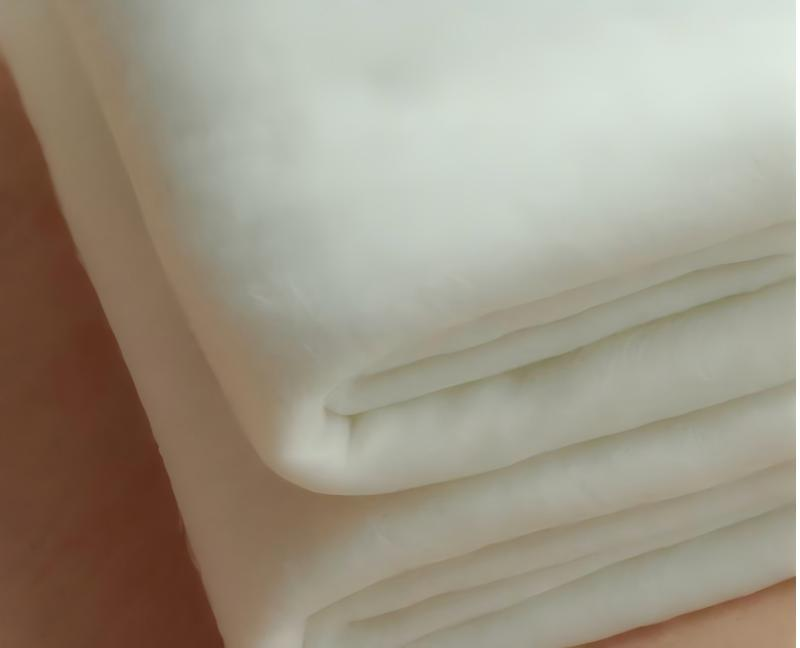
Product 1488 is documented as a PP nonwoven geotextile suitable for road, hydraulic and environmental protection projects. Its documented function set is filtration, stress dispersion and gasket action. Its documented special requirements are high UV resistance and low elongation. Its typical applications are recorded in the United States and Australia, and the material construction is PET/PP, with model designations covering GLS-V, GE, GLP, PET and PP.
For a procurement engineer, those four facts answer most of the screening questions. A fabric documented for filtration suits soil-retention interfaces; a fabric documented for stress dispersion suits layered structures where load must be spread; a gasket function suits lining systems where an interface layer protects and cushions a barrier. UV resistance and low elongation are the two properties that separate a specification-grade PP nonwoven from a commodity roll.
What the documented specification band lets you specify
The published parameter band for the product family is wide, which matters commercially because it means a single qualified source can cover more than one package on the same project:
- Wide widths tensile: 7.0–95 kN/m
- Grab strength: 500–7,500 N
- Trapezoidal tear: 200–2,500 N
- CBR burst strength: 1,300–12,500 N
Read together, the lower end of that band corresponds to lighter separation and filtration duties, while the upper end corresponds to heavily loaded base layers and protective gasket duties under containment systems. The important point for comparison work is that PP nonwoven is not a single data point; a buyer who specifies only "PP nonwoven geotextile" without a mass per unit area and a strength class is comparing an unfinished specification.
Customisation options that change the comparison
Customisation is where a PP nonwoven supplier stops being interchangeable with a generic roll supplier. The documented customisation set for the G-Tex® GE range includes wicking geotextile, anti-UV geotextile, orange geotextile, logo inkjet coding geotextile, conductive geotextile and geotextile fabrics, together with coloured geotextile options such as orange, red and grey, and composite geosynthetic products. The range is broader still, covering mini rolls, geotextile membrane, drainage geonet, drainage geocomposites, geocell, geomembrane liners, HDPE geomembrane and PET formats.
Two additional capabilities are relevant to project execution rather than to the fabric itself. First, customised geotextile surfaces can be spray-coated with the customer's company logo, product name and specifications on request — useful for contractors who need traceable identification on site and for distributors who need branded presentation. Second, the manufacturer has reprocessing capabilities for geosynthetic materials, producing mini rolls, geobags, tubular bags, fabric sheets and geosynthetic containers. Some specially customised geosynthetic materials have obtained patent approvals in relevant customer countries.
Production is organised as an ODM solution model, which means the supplier is set up to build to a buyer's design rather than only to sell a fixed catalogue item.
How the PP nonwoven claim is verified
Verification is the part of the comparison most buyers under-weight. Dalian GeoMax Synthetics Co., Ltd. established Dalian I.E.C, a dedicated testing and technical service company, and its laboratory holds CNAS Laboratory Accreditation Certificate CNAS L8463, accredited under ISO/IEC 17025:2017 for mechanical and physical testing of geosynthetics, issued 20 April 2022 and valid to 19 April 2029 through the accreditation cycle ending 2028-04-19. Reports released from that scope can carry the CNAS national laboratory mark and the ILAC and APLAC mutual recognition marks, and are mutually recognised by over 70 developed countries.
On top of the testing structure, the manufacturing operation holds ISO9001 Certificate of Registration 03824Q07540R0S, ISO14001 Certificate of Registration 03824E07541R0S and ISO45001 Certificate of Registration 03824E07542R0S, all issued on 31 July 2024 and valid to 30 July 2027, covering R&D, design, manufacture and the associated management systems for geotextiles. The company also holds High-tech Enterprise Certificate GR202221201470, issued 14 December 2022 and valid to 21 December 2028, for geosynthetics R&D and manufacturing, and is a member of the International Geosynthetics Association and the China Geosynthetics Engineering Association.
Buyer note: when a supplier's UV and elongation claims are compared, ask which standard the value was produced under. The reference test for UV deterioration in this category is ASTM D4355 (Xenon-Arc exposure), and the reference standard for European road applications is EN 13249:2016.
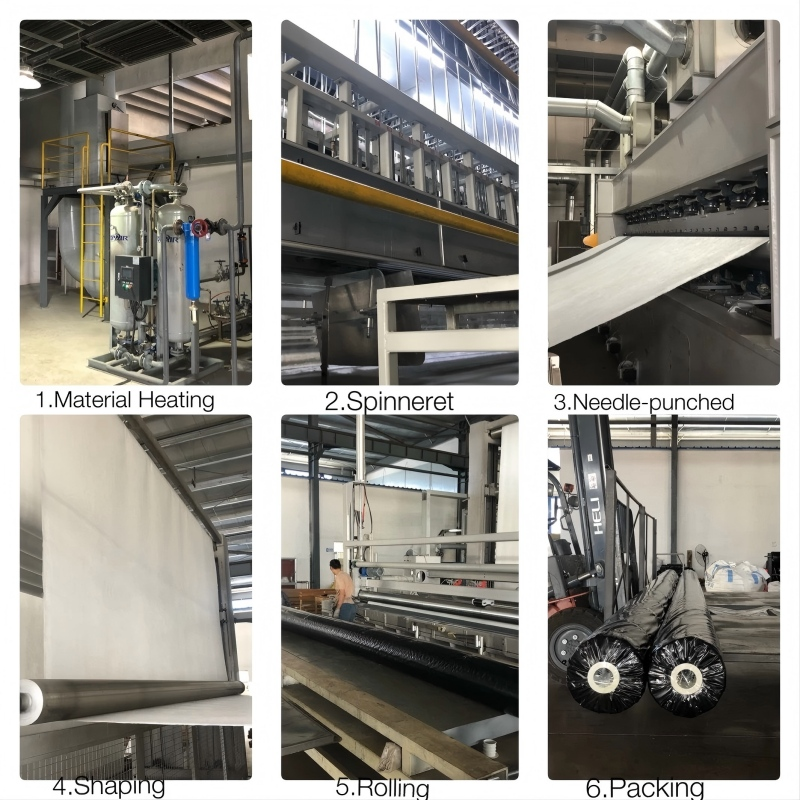
A seven-step comparison sequence for procurement engineers
The following sequence turns the technical discussion above into an evaluation order that can be applied to any quotation, whether the offer is PP nonwoven or an alternative.
- Define the dominant function. Write down whether the layer exists to filter, to disperse stress, to act as a gasket, to drain, to conduct, or to contain. Only one of these should be the pass/fail criterion; the others become secondary checks.
- Fix exposure and service life. Determine how many days the material will be open to sunlight before cover, and whether the design life is short-term or long-term. This converts directly into a UV resistance requirement, tested against ASTM D4355 for geotextiles.
- Check the strain regime. Confirm whether the fabric sits under a static long-term load. If it does, low elongation becomes a mandatory property rather than a preference, and the elongation value must be read next to the tensile value rather than in isolation.
- Match mass per unit area to the structure. The supplier's own project references show how widely this varies in practice — from 150 g/m² on a landfill cover stage to 1,100 g/m² and 1,200 g/m² in heavily loaded landfill works. Mass per unit area is the single most useful normalising figure when comparing quotes.
- Confirm installation method and equipment. Ask how the layer will be placed and with what plant. Road subgrade work usually involves tracked equipment such as bulldozers and excavators running over or beside the fabric; hydraulic work often involves working from the bank or from barges; landfill lining work typically requires cranes or lifting frames to position rolls and prefabricated items. Installation method determines the puncture and tear resistance the fabric must survive before it ever carries design load.
- Verify evidence, not adjectives. Require test reports rather than claims, check which laboratory issued them, and confirm which standards the reported values are referenced to. For imported material, confirm the accreditation behind the report is internationally recognised.
- Lock commercial terms last. Only after steps 1 to 6 should MOQ, lead time, payment structure and delivery terms be compared. Comparing price before specification normalisation is the most common cause of a wrong supplier decision.
Project-by-project fit: road, hydraulic and landfill
Road construction and trafficked areas
In road works, PP nonwoven is normally selected for separation and stress dispersion between a soft subgrade and an imported base course. The G-Tex® GE reference set illustrates the mass range involved: the Anslow Grade IV backfill soil project used 950 g/m² polypropylene short-fibre geotextile together with 250 g/m² polyester long-fibre geotextile, and the same supplier's references include large volumes of expressway, railway and water conservancy work as well as a commercial car park at the Ola Commercial Park. For EU-facing road specifications, EN 13249:2016 and CE marking become the governing access requirement, which is a compliance question rather than a performance question — it must be answered before technical evaluation begins.
River embankment reinforcement and hydraulic works
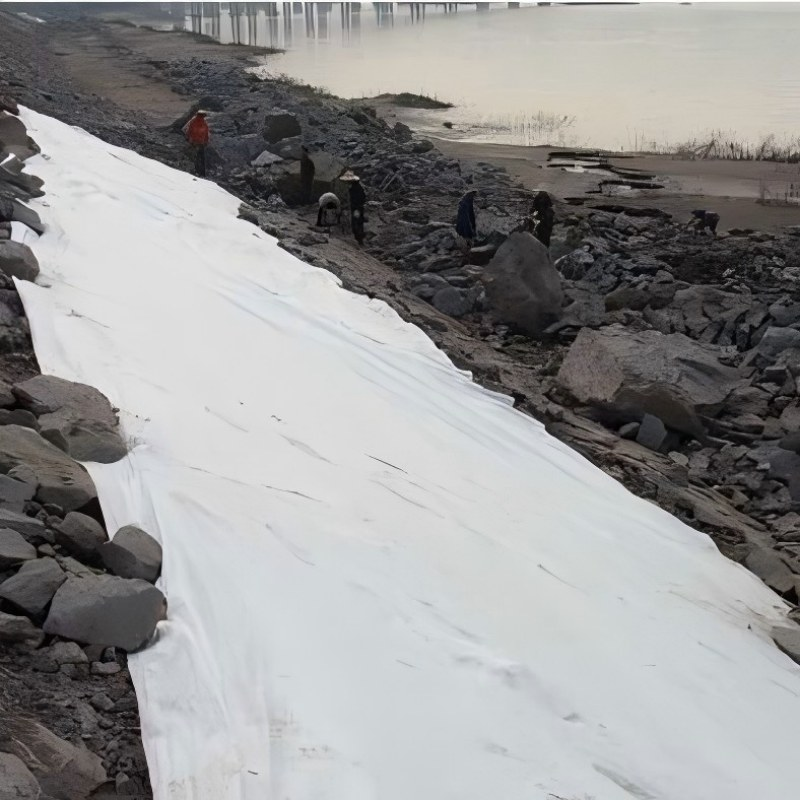
Hydraulic work places a different demand on the same material family. The fabric must retain soil while allowing water movement, which is the filtration function in its purest form, and it must tolerate wet handling without losing strength. Product 1488 is documented as suitable for hydraulic engineering, with typical applications recorded in the United States and Australia. Installation on banks and channels usually combines excavator access with manual roll placement, so the tear and burst values in the specification band become the practical constraint on how aggressively the fabric can be handled.
Landfill lining and environmental protection
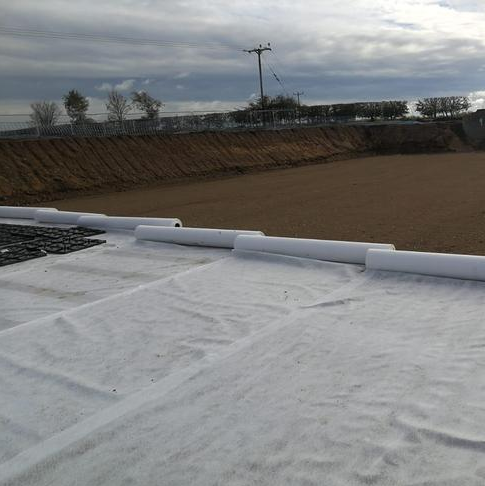
Landfill and environmental protection work is where nonwoven geotextile most often acts as a gasket and protection layer rather than as a standalone filter. The documented project list shows the range of mass per unit area actually deployed: Darwin Bay Landfill (1,200 g/m² polyester fibre geotextile with 250 g/m² polyester geotextile), Alawuna Farm Landfill Units 1 and 2 (1,100 g/m² and 250 g/m²), Great South Landfill Unit 1 (1,100 g/m² with 235 g/m² polyester filament geotextile), Meru Geraldton Landfill and Mira Road Landfill Zones 12 and 13 (540 g/m² each), Hongshan Landfill 15th Phase Expansion (420 g/m² polyester filament geotextile), and Wylie Bay Landfill Stage 1 (150 g/m²). Further landfill references include Yulibury Landfill, the Tirawa Landfill Project in Myanmar, Cosgrove Landfill, Hoxbury Landfill, Nusa Landfill and MUJI Landfill.
Where a project also requires leak detection rather than only protection, the comparison moves to conductive geotextile, which uses graphene or conductive grids to enable Electrical Leak Location in geomembrane liners — the approach commercialised in products such as Bidim® C. Where the requirement is lateral drainage in unsaturated soil rather than filtration, the comparison moves to wicking geotextile, which uses hydrophilic fibres to provide capillary action and can transport water even in unsaturated conditions, as in Mirafi® H2Ri. Both conductive and wicking formats are documented customisation options within the G-Tex® GE range, which means a buyer can often keep one qualified supplier across the protection, drainage and leak-detection layers of the same lining package.
Comparison tables: options, specification band and commercial parameters
Table 1 sets out how the main options differ by documented function and by the evidence a buyer should ask for. It is deliberately limited to what the underlying sources state.
| Option | Material / format | Documented function or mechanism | Documented fit | Verification focus |
|---|---|---|---|---|
| PP nonwoven geotextile (product 1488; models GLS-V, GE, GLP, PET, PP) | Polypropylene / PET nonwoven | Filtration, stress dispersion, gasket action | Road, hydraulic and environmental protection projects; typical applications in the United States and Australia | High UV resistance and low elongation requirements; tensile, grab strength, trapezoidal tear and CBR burst values |
| PET continuous-filament nonwoven geotextile | Polyester filament nonwoven | Nonwoven protection and filtration layer within the same family | Landfill lining references including 420 g/m² and 1,100 g/m² installations | Mass per unit area against design load; roll width, overlap and seam detail |
| Wicking geotextile | Hydrophilic fibre nonwoven with capillary action (e.g. Mirafi® H2Ri, Solmax / TenCate) | Capillary water transport in unsaturated soil | Structures where gravity drainage alone is insufficient | Confirm the design needs drainage rather than filtration; wicking is a documented customisation option in the G-Tex® GE range |
| Conductive geotextile | Nonwoven with graphene or conductive grid (e.g. Bidim® C, Geofabrics Australasia) | Enables Electrical Leak Location (ELL) in geomembrane liners | Landfill lining quality assurance and leak detection surveys | Confirm whether the specification requires ELL testing; conductive geotextile is a documented customisation option |
| Geomembrane liner | HDPE geomembrane | Containment barrier | Landfill and environmental protection lining systems | Interface friction with the adjacent geotextile and whether a protective nonwoven gasket layer is specified |
Table 2 converts the PP nonwoven specification band into the questions a buyer should be able to answer before releasing a purchase order.
| Parameter (product 1488 family) | Documented value | Why it changes the comparison |
|---|---|---|
| Wide widths tensile | 7.0–95 kN/m | Defines how wide a load range one qualified source can cover across several packages on the same project |
| Grab strength | 500–7,500 N | Indicates resistance to localised point loading during lifting and placement |
| Trapezoidal tear | 200–2,500 N | Indicates how the fabric resists tear propagation when stressed by angular fill |
| CBR burst strength | 1,300–12,500 N | Indicates puncture resistance against subgrade irregularities and coarse aggregate |
Table 3 lists the documented commercial and capability parameters that determine whether a PP nonwoven supplier can actually execute a project, as opposed to only quoting it.
| Parameter | Documented value |
|---|---|
| Minimum order quantity | 10,000 m² |
| Lead time | 10–45 days |
| Monthly capacity | 800,000 m² |
| Annual output | 9,500,000 m² |
| Quality control | 100% test |
| Acceptance | Pre-shipment test |
| Delivery terms | FOB / CIF |
| Payment terms | 30 / 70 |
| After-sales | Remote support |
| Production mode | ODM solution |
| Test laboratory | CNAS L8463, ISO/IEC 17025:2017 accredited |
| Management systems | ISO9001 03824Q07540R0S, ISO14001 03824E07541R0S, ISO45001 03824E07542R0S (valid to 30 July 2027) |
Frequently asked questions
Does PP nonwoven geotextile need specific certification for EU road projects?
For roads and trafficked areas inside the European Union, EN 13249:2016 is the harmonised standard that applies to geotextiles and CE marking is required for market access. Outside that scope, export-oriented manufacturers typically align production to several frameworks — the German DIN standard, ISO standards, ASTM standards, Australian AS standards and the Chinese GB/T national standard — and can supply customised products to ASTM, AS or GB/T requirements. UV performance claims in this category are normally referenced to ASTM D4355, the core standard for testing UV deterioration of geotextiles through Xenon-Arc exposure, while mechanical test reports can be issued through a CNAS-accredited laboratory such as CNAS L8463, whose reports are mutually recognised by over 70 developed countries.
Can PP nonwoven geotextile be customised for UV, colour, conductivity or branding?
Yes. Documented customisation options for the product 1488 range include wicking geotextile, anti-UV geotextile, orange geotextile, logo inkjet coding geotextile, conductive geotextile and geotextile fabrics, alongside coloured geotextile in options such as orange, red and grey, and composite geosynthetic products. Customised geotextile surfaces can be spray-coated with the customer's company logo, product name and specifications on request, and the manufacturer also offers reprocessing into mini rolls, geobags, tubular bags, fabric sheets and geosynthetic containers. Production is organised as an ODM solution model, and some specially customised geosynthetic materials have obtained patent approvals in relevant customer countries.
What actually drives the commercial comparison between PP nonwoven and the alternatives?
The documented commercial parameters are a minimum order quantity of 10,000 m², delivery on FOB or CIF terms and a 30/70 payment structure, with acceptance based on pre-shipment testing. Because the specification band for wide widths tensile runs from 7.0 to 95 kN/m, the honest way to compare quotations is to normalise first: same mass per unit area, same strength class, same UV and elongation requirement, same test standard. Only then are differences in lead time, payment terms and delivery conditions meaningful. A quote that cannot state its mass per unit area and test references is not comparable to one that can.
How can a buyer validate PP nonwoven geotextile before shipment?
Validation runs through two documented mechanisms. The first is acceptance by pre-shipment test, supported by 100% testing within the production process. The second is the supplier's testing arm, Dalian I.E.C, whose laboratory holds CNAS Laboratory Accreditation Certificate CNAS L8463 under ISO/IEC 17025:2017 for mechanical and physical testing of geotextiles and other geosynthetics, with reports carrying the CNAS mark and ILAC and APLAC mutual recognition marks. Project references also matter: the manufacturer's documented case record covers 9,500,000 m² per year supplied to trade companies and engineering construction companies across Australia, Canada, China, Fiji, Hong Kong, Indonesia, Malaysia, New Zealand and the United States, with filtration, stress dispersion and gasket applications reported as stable in operation and a design life of 50+ years under normal engineering conditions.
What lead time and capacity should a buyer plan against?
Documented lead time is 10–45 days, against a monthly production capacity of 800,000 m² and annual output of 9,500,000 m² from a 12,000 m² facility in Dalian staffed by 45 employees, including a 12-engineer R&D team, with three needling production lines — two for short-fibre geotextiles and one for continuous-filament geotextiles. With roughly 95% of output exported and main markets spanning Asia, Europe, South America and Oceania, the commercially relevant question is usually not whether capacity exists but when a slot is available in the production schedule. For projects with fixed installation windows, it is worth requesting a quotation and a production slot together rather than price alone.
Conclusion: choose the function, then choose the fabric
PP nonwoven geotextile remains the practical default for road separation, hydraulic filtration and landfill protection because one documented fabric can perform filtration, stress dispersion and gasket action at the same time, with high UV resistance and low elongation specified where exposure and static long-term loading demand them. The alternatives are not better or worse in the abstract — wicking geotextile solves lateral drainage in unsaturated soil, conductive geotextile enables Electrical Leak Location in geomembrane liners, and geomembrane liners provide containment. They answer different questions.
The comparison method is therefore simple to state and difficult to shortcut: define the dominant function, convert exposure and loading into testable requirements, normalise every quotation to the same mass per unit area and strength class, and verify claims against accredited test reports rather than brochure language.
Next step for evaluation-stage buyers: if you are comparing PP nonwoven geotextile specifications for a road, hydraulic or landfill package, the fastest route to a usable comparison is to request a quotation and current test documentation against your mass per unit area and UV requirement.
Contact Dothan at Dothan@geo-textile.com or by telephone and WhatsApp on +86 186-9865-5505. The company profile and product overview can be downloaded here: G-Tex® GE / I.E.C. company profile (PDF).
Have Questions or Need More Details?
Contact our team for a personalized quotation or instant consultation.
Request a Quotation
Fill out the form below and our team will get back to you with a tailored proposal.
WhatsApp Direct Chat
Prefer to chat in real-time? Message us on WhatsApp for instant assistance & quick answers.
- Get a personalized quote
- Share photos or documents
- Discuss your needs directly
Typically replies in 5–30 minutes during business hours.