
What Is PP Nonwoven Geotextile? A Beginner's Guide to the Material Behind the Roll
PP nonwoven geotextile is a polypropylene fabric supplied in rolls, in which fibres are mechanically entangled by needle punching instead of being woven, and which is placed in contact with soil, aggregate or water to filter, spread stress, and separate or cushion the materials around it. If a drawing, a bill of quantities or a supplier datasheet has put a roll of this material in front of you for the first time, the useful questions are narrow: what the material actually is, which engineering situations it suits, and what has to be confirmed before the roll is loaded.
This guide answers those questions in plain language for first-time buyers and specifiers who are past the browsing stage and moving towards an order. It explains the material itself, the three functions it performs in road, hydraulic and environmental protection works, where demand comes from in markets such as the United States and Australia, and how the commercial terms of a first purchase — minimum quantity, delivery basis, payment split and pre-shipment testing — affect the decision.
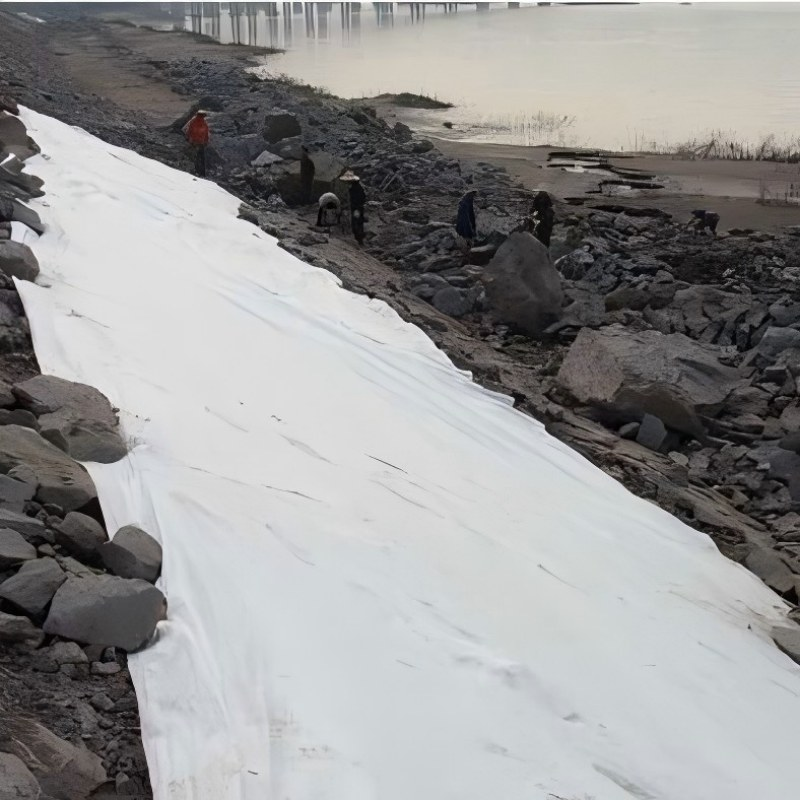
Geotextile laid for riverbank protection: the roll is a filter, a stress-spreading layer and a separator at the same time.
The short definition a buyer can reuse
Three words carry the definition, and each one matters commercially.
PP identifies the polymer: polypropylene. It is the raw material the fibres are spun from, and it is the reason the finished sheet is normally described as a polypropylene geotextile rather than simply a geotextile.
Nonwoven describes the construction. There is no weaving and no warp-and-weft structure. Supplier descriptions of the staple-fibre process set out the same core sequence: fibres are carded and laid or cross-laid into a web, then needle punched so that barbed needles drag filaments vertically through the web and lock it together, after which the sheet is cut and rolled. Needle punching is what gives the fabric its felt-like hand, its thickness and its ability to deform slightly around stones instead of splitting at a single point.
Geotextile places it in the geosynthetics family and describes its job: a permeable textile used in contact with soil or rock as part of a civil engineering works. It is not a geomembrane, because it does not exist to block water; it is not a geogrid, because it does not derive its function from a regular open mesh.
Product documentation for the G-Tex GLP range, a polypropylene nonwoven line, sets out mass-per-unit options from 140 g/m² to 900 g/m², with approximate roll lengths running from about 300 m at the light end down to about 45 m at the heavy end of that range. Thickness in the same documentation is measured under 2 kPa confining pressure in accordance with ASTM D5199. Those two examples show why "a roll of geotextile" is not a single product: a 140 g/m² roll and a 900 g/m² roll share a name and almost nothing else in handling terms.
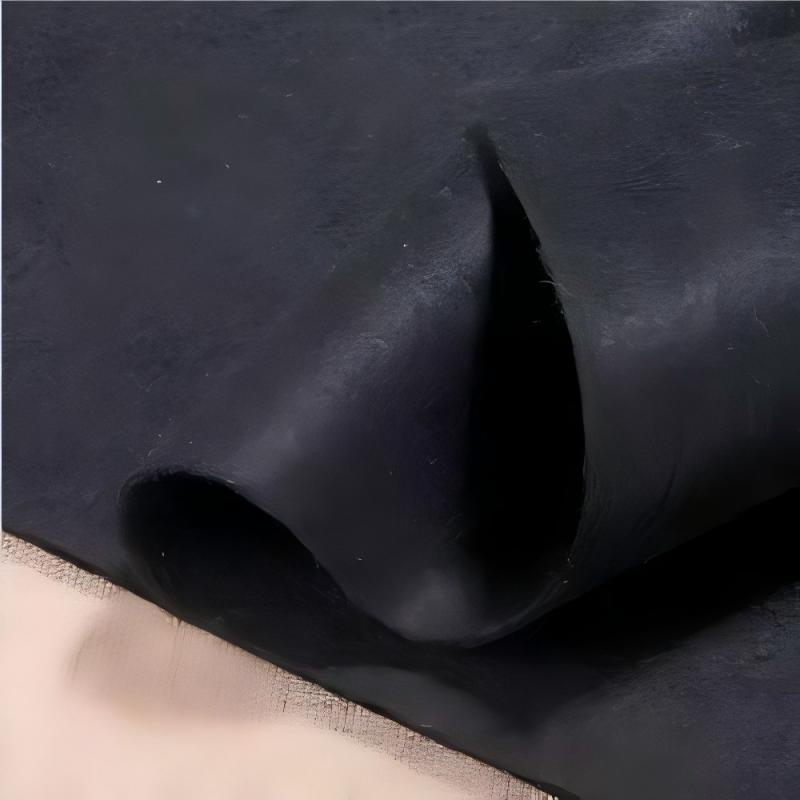
Black PP staple-fibre nonwoven geotextile: needle-punched polypropylene supplied in roll form.
The problem the material solves on site
Nearly every application of PP nonwoven geotextile starts with the same problem: two materials with different particle sizes are pressed together, and water is moving through them.
Left alone, that situation produces three predictable failures. Fine particles migrate from one layer into the voids of the other, so a graded granular layer slowly loses the fines that made it graded. The two materials intermix at the interface, so a designed friction and bearing condition becomes an undefined one. And where a coarse layer sits on a softer one, individual stones concentrate load at points and punch into the surface beneath. All three reduce the performance the design assumed, and none of them is visible after backfilling.
A needle-punched polypropylene sheet interrupts that process because it is porous but fine. Water passes; particles above a certain size are held back on the soil side; and the fabric's thickness distributes a point load over a small but useful area. The three functions — filtration, stress dispersion, and the gasket or separation role — are the same mechanism viewed from three different angles, which is why a single specification decision often covers more than one requirement.
What makes the material's service conditions unusual is that they are static and long. Once installed and buried, the fabric does not move, flex or cycle in the way a mechanical component does. It sits under a steady overburden load, in permanent contact with soil and often with water, while exposed to weather during storage and installation. The performance question is therefore not peak strength but durability: whether the sheet keeps filtering and separating for the design life of the works. The company's case record states a design life of 50+ years under normal engineering conditions, with a stated service range of 50 to 100 years — a company statement about its own products, useful as a design input to be confirmed against project requirements, not an independent certification.
How it fits road, hydraulic and environmental protection engineering
The material earns its place in three engineering families, and understanding the difference between them is the fastest way for a new buyer to read a specification correctly.
Roads and pavement construction
In road works the fabric is normally placed between the prepared subgrade and the granular base or sub-base. There it performs separation and filtration at once: it stops subgrade fines pumping upward into the granular layer under traffic loading, and it keeps the drainage path open so water can move out of the pavement structure rather than softening what is beneath it. Its stress dispersion role is second-order here — it spreads localised bearing pressure from coarse aggregate, but it is not a substitute for a geogrid when the design requires tensile reinforcement of the base course.

Geotextile laid on a highway subgrade before granular base placement.
Hydraulic works and river embankment reinforcement
In hydraulic engineering the fabric usually sits behind a revetment, riprap or concrete element, where it works as a filter under reversing or steady seepage. Its task is to let water out of the embankment while holding the soil in place, so that the structure above is not undermined by the loss of fines through joints and gaps. In river embankment reinforcement this filtration role is the primary one; separation between the embankment soil and the armour layer follows from it. The supplier's application image set includes laying for riverbank protection, and its project record covers water conservancy works among the fields it supplies.
Environmental protection and landfill lining
In landfill lining and cover systems, the fabric typically acts as a protection and separation layer rather than as the barrier itself. It cushions a geomembrane against puncture from drainage gravel or from a prepared subgrade, keeps a drainage layer from intermixing with the waste or cover soil, and provides the gasket function between dissimilar materials that must not bond or abrade. The company's environmental record covers multiple landfill units across several markets, with documented geotextile specifications from 150 g/m² to 1,200 g/m² depending on the unit and the layer — a useful reminder that landfill work is usually a multi-specification order rather than a single-roll purchase.
Where demand comes from in the United States and Australia
Both markets appear repeatedly in the supplier's commercial record. The export market list names Australia and the United States among more than 30 destination countries, and the case record lists AU and US among client countries. That is a statement about where the material is shipped, not a demand forecast: this guide contains no verified market-size figure for either country, and readers should treat application-based demand signals accordingly.
The demand pattern those markets represent is nonetheless recognisable. Road rehabilitation and subgrade separation, river and coastal protection works, and landfill lining and closure programmes all consume PP nonwoven geotextile in roll quantities, and all three are specification-driven rather than price-only purchases. For category context, IMARC Group valued China's geotextiles market at USD 1.6 billion in 2025, and China's total textile exports reached USD 141.96 billion in 2024, up 5.7% year on year according to China Customs — the second figure covers textiles broadly rather than geotextiles specifically, and neither figure should be read as a forecast for a single buyer's project.
The three core functions, explained one at a time
1. Filtration
Filtration is the function most often misunderstood on a first order. The fabric is not a sieve in the everyday sense, and it is not meant to be the finest filter available. It has to satisfy two opposing conditions at once: allow water to pass at a rate the design can tolerate, and retain enough of the surrounding soil that the structure behind it stays stable. A fabric that is too open loses fines; a fabric that is too tight clogs, and a clogged filter behaves like a blocked drain.
The practical consequence is that filtration performance has to be specified together with the soil, not chosen from a catalogue in isolation. Filtration behaviour is normally described through pore-size and permeability data, and the supplier should be asked which test methods support the values quoted. In the case record for this product family, filtration is listed as the first of the three applications the material serves.
2. Stress dispersion
Stress dispersion is the ability to spread a concentrated load across a wider area before it reaches the layer below. A needle-punched nonwoven does this partly through its thickness and partly through its ability to deform locally without tearing: a stone pressing into the sheet is partly enveloped, and the pressure it transmits is distributed over a larger contact area.
For a buyer, the important distinction is between dispersion and reinforcement. Dispersion reduces the peak pressure a soft subgrade or a geomembrane experiences. Reinforcement of a granular layer in the structural sense is a different function, usually delivered by a product with tensile properties designed for that purpose. Confusing the two leads to under-specified pavements and over-specified separator layers.
3. Gasket and separation
The third function is described in the product's application record as the gasket role. In practice this means the fabric keeps two materials apart and cushions them against each other: it prevents a granular drainage layer from intermixing with the soil beneath it, and it prevents a geomembrane or a concrete element from being abraded or punctured by the material next to it. Because the fabric is compressible, it also accommodates small irregularities rather than transferring them as point loads.
The gasket and separation role is often the least expensive part of a specification and the most expensive to get wrong, because a failed separator is only discovered when a layer has already lost its designed grading or a liner has already been compromised.
| Function | What the fabric does | Typical setting | What to confirm before ordering |
|---|---|---|---|
| Filtration | Passes water while retaining soil particles on the upstream side | Behind revetments, below pavement layers, around drainage media | Test methods behind pore-size and permeability values; soil conditions the fabric will contact |
| Stress dispersion | Spreads a point load over a wider contact area | Coarse aggregate over soft subgrade; gravel over a liner | Mass per unit and thickness appropriate to the load; not specified as a substitute for reinforcement |
| Gasket / separation | Keeps dissimilar layers apart and cushions contact between them | Geomembrane protection in landfill lining; drainage layer separation | Puncture and burst values; placement and overlap detailing |
From roll to purchase order: a seven-step breakdown
A first order of PP nonwoven geotextile becomes straightforward once the specification is converted into a short, written sequence. The steps below follow the order in which they affect each other.
- Step 1 — Name the function, not the product. Write down which of the three functions the layer must perform, and in what order of priority. Filtration and separation often come together; dispersion usually needs a heavier sheet than filtration alone would require.
- Step 2 — Fix mass per unit and roll dimensions. Mass per unit is the first number in any geotextile conversation, because it anchors handling, cost and most mechanical properties. The G-Tex GLP documentation ranges from 140 g/m² to 900 g/m², with roll length decreasing as mass increases; confirm width, length and roll weight against the lifting equipment on site.
- Step 3 — Name the test methods and the acceptance values. The declared test categories for this polypropylene range are mass per unit (ASTM D5261), tensile strength (ASTM D4595), grab strength (ASTM D4632), trapezoidal tear (ASTM D4533), CBR burst strength (ASTM D6241), thickness (ASTM D5199) and puncture resistance (ASTM D4833). The method defines how a value is measured; your project then sets the value it will accept.
- Step 4 — Match the specification to the exposure. Buried, water-contact, statically loaded service is the normal case, but storage and installation are not: the roll sits outdoors before it is placed. Where the fabric will remain exposed rather than buried, an anti-UV grade is the relevant option rather than a heavier standard sheet.
- Step 5 — Agree placement and jointing. Fabric performance on paper means nothing if the installed layer has gaps, laps in the wrong direction against water flow, or damage from construction traffic. Ask for the supplier's installation guidance and confirm who on site is responsible for lap direction and repair of tears.
- Step 6 — Fix the commercial terms. Minimum order quantity, delivery basis, payment split and lead time are covered in the section below. These four items determine most of the cash and logistics exposure in a first purchase.
- Step 7 — Review the pre-shipment test before the balance payment. Testing before shipment is the point at which a specification either becomes evidence or stays an intention.
Documented use cases
Concrete project records are more useful than generic claims, and the case record for this product family contains several. In the Anslow Grade IV backfill soil project, the documented specification combines a 950 g/m² polypropylene short-fibre geotextile with a 250 g/m² polyester long-fibre geotextile — an example of a single works using two different geotextiles for two different layers. In municipal works, the parking lot at the Ola Commercial Park is listed alongside expressway, railway and water conservancy projects supplied with geotextiles and geosynthetic materials, together with technical consulting. In hydraulic applications, riverbank protection laying is part of the documented application set, matching the filtration-behind-armour role described above.
Across the record as a whole, the listed client types are trading companies and engineering construction companies, and the stated annual supply volume is 9,500,000 m². For a first-time buyer, the practical reading is that the material is a repeat-purchase item on real projects rather than a special-order product, which is why the order terms below are standardised rather than negotiated case by case.
Customization and ODM capability
Beyond the standard black roll, the documented customization options for this product family include coloured geotextile (orange and other colours), anti-UV geotextile, wicking geotextile, conductive geotextile, Logo Inkjet coding geotextile and geotextile fabrics. Surfaces can be spray-coated with the customer's company logo, product name and specifications on request, and the manufacturer also offers ODM solution production services for geotextile products.
Reprocessing capability extends beyond flat roll supply: the company produces mini rolls, geobags, tubular bags, fabric sheets and geosynthetic containers. Some specially customized geosynthetic materials have obtained patent approvals in relevant customer countries.
What this means in procurement terms depends on who is buying. A distributor can carry a branded roll and a set of finished formats without building a converting operation. A contractor can order a project-specific format — a mini roll for a confined space, a geobag for a revetment — rather than cutting standard rolls on site. A brand owner can specify a printed surface for identification and traceability across a site. Each of those options changes the production route, so the customization should be stated in the enquiry and confirmed in the quotation rather than assumed from a general catalogue.
Procurement terms: what a first order looks like
The commercial framework for this material is short enough to state completely, and a first-time buyer should see it before comparing quotations.
| Term | Stated value | What it means for the buyer |
|---|---|---|
| Minimum order quantity | 10,000 m² | Sets the smallest viable order; plan take-off quantities against this floor before requesting a quote |
| Delivery terms | FOB or CIF | FOB leaves main carriage and insurance with the buyer; CIF places them with the seller up to the destination port |
| Payment terms | 30% deposit, 70% before shipment | Most of the payment falls due before the goods leave, so pre-shipment testing is the buyer's main control point |
| Acceptance criteria | Pre-shipment test | Test results are reviewed before the balance is paid and before loading |
| Production lead time | 10–45 days | Schedule depends on specification, colour or customization and on the shipping route |
The company behind the G-Tex® GE brand is Dalian GeoMax Synthetics Co., Ltd., a Dalian-based Chinese geotextile manufacturer that exports geotextiles and geosynthetics to more than 30 countries, states a 95% export ratio, and operates an ISO 9001, ISO 14001 and ISO 45001 certified management system (certificate numbers 03824Q07540R0S, 03824E07541R0S and 03824E07542R0S, all valid to 30 July 2027). Its plant is stated at 12,000 m² with 45 employees, a 12-engineer R&D team, two short-fibre needled geotextile lines and one long-fibre needled line, monthly capacity of 800,000 m² and annual output of 9,500,000 m². The company also holds High-tech Enterprise Certificate GR202221201470, valid to 21 December 2028, and reports more than 80 patents related to geotextile and geosynthetic processes and equipment.
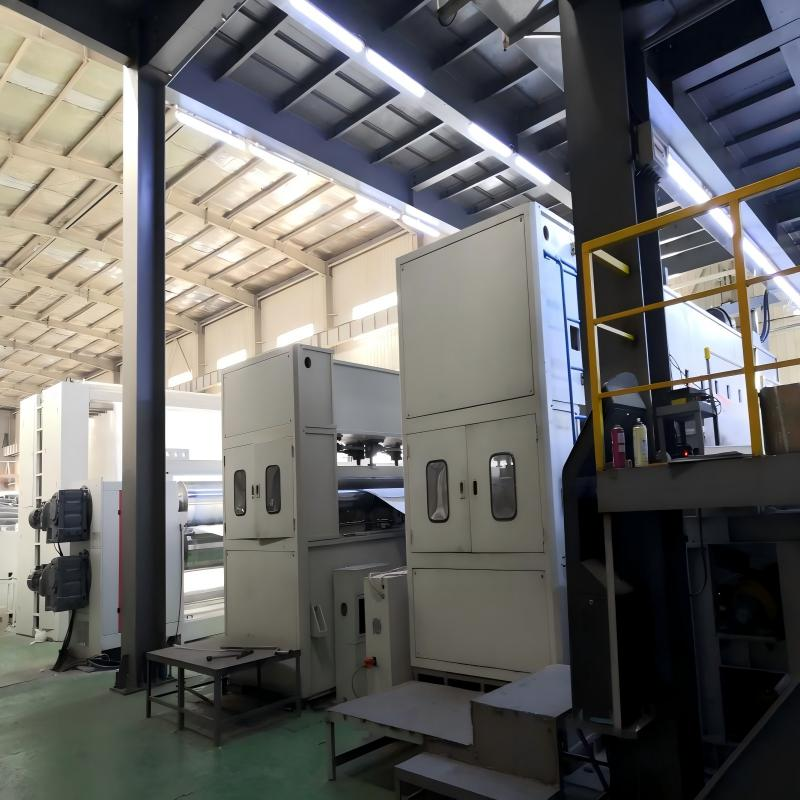
Needle punching is the process step that turns a fibre web into a nonwoven geotextile.
Testing is the part of this framework that carries the most weight, because 70% of the payment falls due before shipment. Dalian I.E.C Testing Service Co., Ltd., established by the same company in 2012, holds CNAS laboratory accreditation under registration CNAS L8463 to ISO/IEC 17025:2017 for mechanical and physical testing of geosynthetics including geotextile, geomembrane and geocell, valid to 19 April 2028. Within the accredited scope, reports carry the CNAS mark together with the ILAC and APLAC international mutual recognition marks and are described as mutually recognised by more than 70 developed countries. Quality control on production is described as 100% testing, and pre-shipment testing is the stated acceptance criterion on every order.
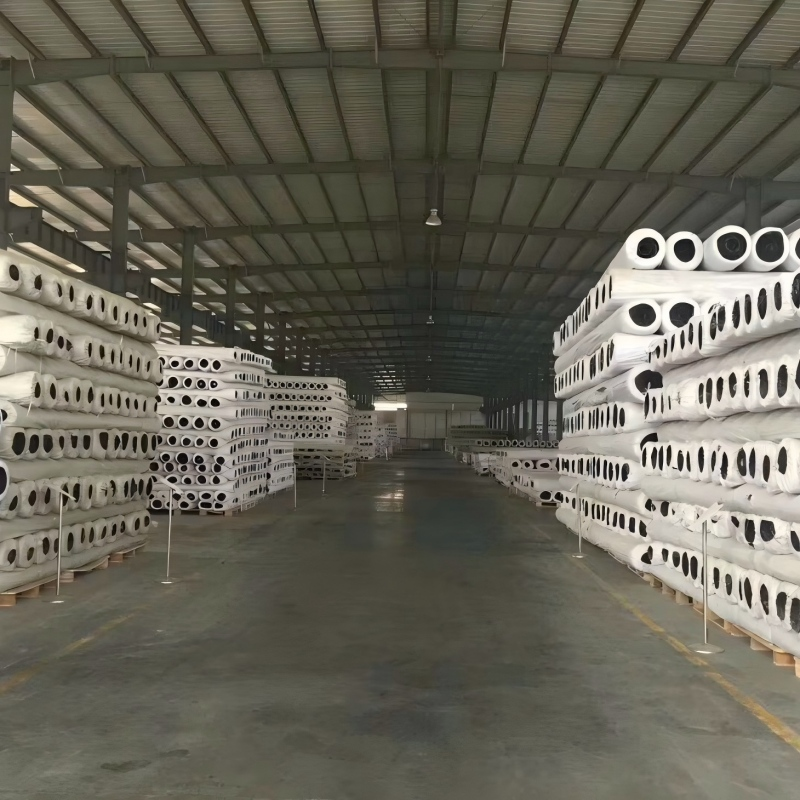
Finished rolls in the warehouse: pre-shipment testing is the acceptance point before the balance payment and loading.
Frequently asked questions
Which standards and test methods should a PP nonwoven geotextile order reference?
Product documentation for the G-Tex GLP polypropylene nonwoven range declares seven ASTM test categories: mass per unit (ASTM D5261), tensile strength (ASTM D4595), grab strength (ASTM D4632), trapezoidal tear (ASTM D4533), CBR burst strength (ASTM D6241), thickness (ASTM D5199) and puncture resistance (ASTM D4833). Thickness is measured under 2 kPa confining pressure in line with ASTM D5199. The manufacturer states that its geotextiles are produced to meet DIN, ISO, ASTM, AS and GB/T requirements and can be supplied against ASTM, AS or GB/T specifications on request, and its management systems are certified to ISO 9001, ISO 14001 and ISO 45001. Declared test categories are a starting point for an enquiry: the acceptance values still have to be agreed for the specific project.
Can PP nonwoven geotextile be customized — colour, logo, wicking, anti-UV or conductive grades?
Yes. Documented customization options include coloured geotextile (orange and other colours), anti-UV geotextile, wicking geotextile, conductive geotextile and Logo Inkjet coding geotextile. Surfaces can be spray-coated with the customer's company logo, product name and specifications on request, and the company also reprocesses geosynthetics into mini rolls, geobags, tubular bags, fabric sheets and geosynthetic containers. Production is offered as an ODM solution, and some specially customized geosynthetic materials have obtained patent approvals in relevant customer countries. Because each option changes the production route, it should be written into the enquiry and confirmed in the quotation.
What is the minimum order quantity, and what payment and delivery terms apply?
The stated minimum order quantity is 10,000 m². Delivery is quoted on FOB or CIF terms, and the payment schedule is 30% deposit with the remaining 70% payable before shipment. Those four items — minimum quantity, Incoterm, deposit ratio and balance timing — account for most of the cash and logistics exposure in a first order, and all four should appear in writing in the quotation alongside the specification and the agreed test values.
Is testing carried out before shipment on every order?
Pre-shipment testing is the stated acceptance criterion on every order, and production quality control is described as 100% testing. Testing is supported by Dalian I.E.C Testing Service Co., Ltd., a CNAS-accredited laboratory under registration CNAS L8463, accredited to ISO/IEC 17025:2017 for mechanical and physical testing of geotextiles, geomembranes and geocells, with the accreditation valid to 19 April 2028. Test reports issued within the accredited scope carry the CNAS mark and the ILAC and APLAC mutual recognition marks, and are described as mutually recognised by more than 70 developed countries — which matters when a project engineer in the destination market has to accept the document.
How long does production take, and how much capacity sits behind the order?
Production lead time is stated as 10–45 days, supported by monthly capacity of 800,000 m² and annual output of 9,500,000 m². A 10,000 m² minimum order therefore represents a small share of a month's output, but the actual schedule depends on the mass per unit, any colour or customization requested, and the shipping route, so the delivery date should be confirmed in writing rather than inferred. If you would like a specific specification checked against that schedule, send the mass per unit, roll width, order quantity and destination port for a written quotation.
Conclusion
PP nonwoven geotextile is a needle-punched polypropylene sheet that earns its place in a structure through three simple jobs: filtering water without losing soil, spreading stress so a soft layer is not punched, and separating or cushioning the materials on either side of it. In road, hydraulic and environmental protection works it performs those jobs under static, long-term, buried and water-contact conditions, which is why the specification is written once and then trusted for the design life of the works rather than adjusted on site.
For a first-time buyer at the evaluation-to-execution stage, the sequence that reduces risk is also the shortest one: define the function, fix the mass per unit and test methods, match the grade to the exposure, and settle the order terms — 10,000 m² minimum, FOB or CIF, 30% deposit with 70% before shipment, and a pre-shipment test reviewed before the balance is paid. Everything else in the quotation is detail on top of those decisions.
Next step: the full company and testing profile is available in the downloadable brochure, which covers production lines, standards, laboratory accreditation and export markets: G-Tex® GE / I.E.C. company profile (PDF). Sample and quotation requests can be sent with your specification, quantity and destination port to Dothan@geo-textile.com or by phone and WhatsApp on +86 186-9865-5505.
Have Questions or Need More Details?
Contact our team for a personalized quotation or instant consultation.
Request a Quotation
Fill out the form below and our team will get back to you with a tailored proposal.
WhatsApp Direct Chat
Prefer to chat in real-time? Message us on WhatsApp for instant assistance & quick answers.
- Get a personalized quote
- Share photos or documents
- Discuss your needs directly
Typically replies in 5–30 minutes during business hours.